
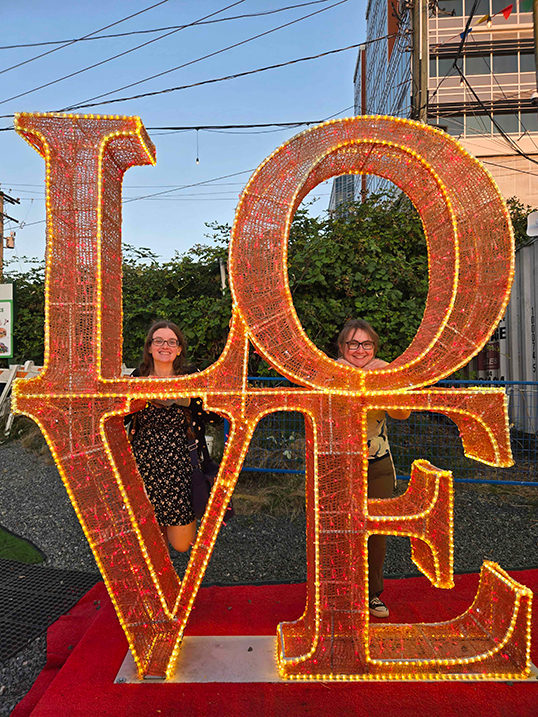
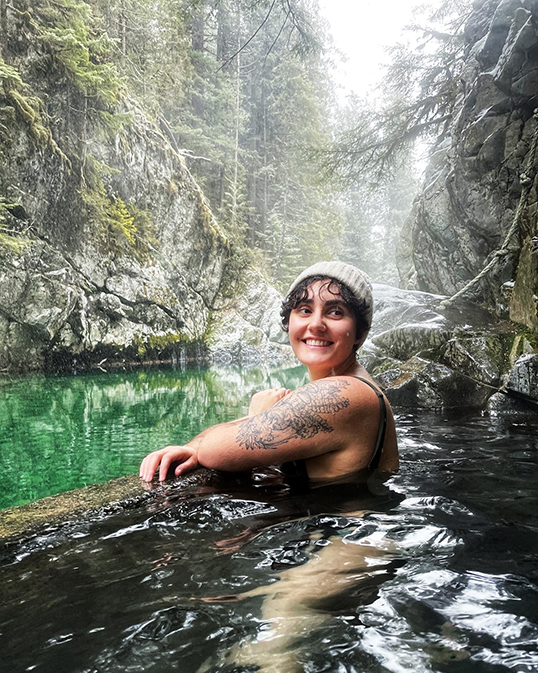
Alex, community member of the aces and aros discussion group.
“There’s a part of me that doesn’t really like [Valentine’s Day], but there’s another part of me [that sees it] as fun and kitsch,” she says. “Let people have their fun.”
She adds that St. Valentine’s was also the patron Saint of beekeeping. The discussion group runs on the last Saturday of every month – except for December – at Yaletown Roundhouse Community Centre. It is affiliated with QMUNITY’s Aces & Aros Support Group.
Open for discussion
Each session begins with introductions, then the floor is opened for discussion. Participants engage in small group discussions, followed by a bigger one. They also have the option to join a social activity afterwards.
“You don’t have to talk in the discussion group – just come out and join,” Mulder adds. “You can sit and listen, people do it all the time, it’s totally fine.”
Community member Alex found the group during a Pride event two years ago. They see the group as a “linchpin” to the community’s other initiatives, including a newsletter, Discord server, Facebook and meetup groups.
“Going to the discussion group was super helpful because you understand, ‘This is the general vibe of the community,’” they share. “It’s been a really fulfilling and wonderful community to be a part of.”
Alex adds that the members have “wide and varied interests,” which is reflected in the diversity of their activities. These activities have included beach days, trying out new restaurants and even planning a karaoke night.
“Because the discussion groups can be quite big, people have gotten into smaller friendship groups,” they add.
“We definitely want to make it a space that is comfortable for people who are like, ‘I would like to explore this, but I don’t want this to be something I tell everyone about just yet,’” says Mulder.
An ever-changing experience
Mulder started identifying as asexual at the age of 17. It was through Tumblr – a social media and microblogging platform – where she first had the realization. Known as a queer, leftist space, Tumblr was also key to Alex’s learning of asexuality and aromanticism.
“You stumble upon the term once in something, then you stay up till 2 a.m. going down a rabbit hole,” Mulder recalls. “A few years after [identifying as asexual], I started identifying as aromantic in a little bit more of a wishy-washy, try it on, took it off kind of way.”
It took Alex most of their early 20s to become comfortable with being ace. Like Mulder, Alex’s identification with aromanticism came a couple of years later.
“I was very resistant to the idea of being asexual or aromantic for a very long time because there were a lot of associations with both [identities] that I didn’t like,” Alex recalls. “I fell into my identity through stepping backwards into it.”
Alex describes their aromantic/asexual identity as “less like a set definition” and more “amorphous, ambiguous” – a nod to how both queerness and life are always changing.
The two point out harmful stereotypes associated with those on the ace/aro spectrum, such as being emotionless, robotic and socially inept. Both emphasize that those who identify as aromantic and/or asexual may choose to be in a sexual, romantic or other form of partnered relationship. The ace/aro lived experience is diverse.
Mulder – who has decided not to partner – must consider how to “navigate a life where singleness is permanent.” She adds that cost of living or illness concerns become more pressing as one gets older.
“What does family mean as you age? What do support networks mean as you get sick?” she asks. “Most people lean on romantic partners for a lot of those things, but if that’s not accessible to you, then how do you access care that you need and give care that you might want to give?”
While Mulder is still figuring out the answers, she has opted to live in a collective house. The housemates share domestic labour and grocery costs. They also participate in egalitarian decision making.
“One of my favourite things about Valentine’s Day is that the Aromantic Spectrum Awareness Week is always the week after Valentine’s Day,” says Mulder. “I love that the organizers’ choose to have it be a thing – I think it’s hilarious.”
For more information, see www.qmunity.ca/service-page/aces-aros-support-group


Comments will load once you reach the end of the article.