
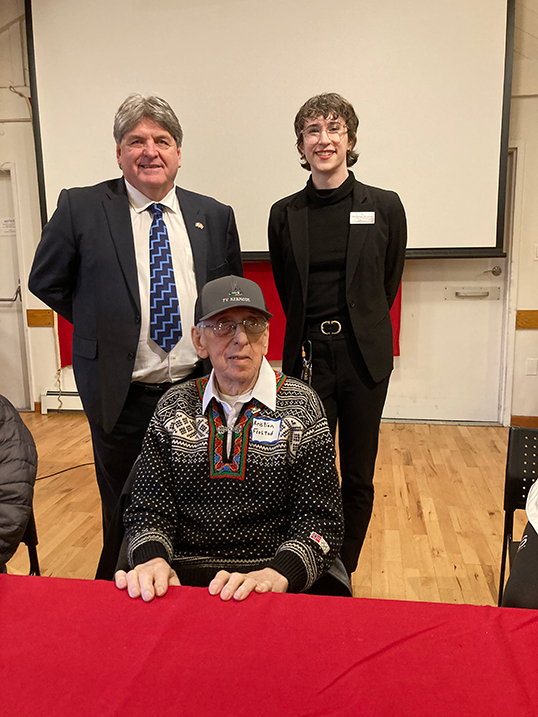
Kristian Frostad (front) with Norwegian Honorary Consul General Randall Kaardal (left) and Jules Moses-Coats, MMBC Collections Manager (right).
“For over 70 years, the Maritime Museum of British Columbia has sought to engage communities in witnessing and preserving maritime heritages,” says MMBC’s collections manager Jules Moses-Coats. “Vessels are characters in our maritime history: They are all players on the stage – we’re always looking to gather portraits of these characters.”
Hosted by the Norwegian House Society, over 100 attendees – including fellow boatbuilders, fishers and local Nordic community members – gathered to view the collection. Norwegian Honorary Consul General Randall Kaardal brought greetings from the Norwegian Embassy in Ottawa.
“We were overjoyed to hear that Kris was going to be offering these plans to us,” Moses-Coats adds. “Our collections committee who decides what we accept and what we don’t are very familiar with Kris’ work – they are all longtime mariners.”
“Kris always recognized that the work he and others did in boat building contributed to the history of B.C., to the development of vessel design over his 60 years in the business, and to the marine industry,” says donation organizer Marian Toft.
The handover
A master boatbuilder, Frostad came to New Westminster from Tomrefjord, Norway in 1956/57. After returning to Norway to learn more boat building skills, he eventually settled in B.C.’s lower mainland.
“With a long coastline, Norway has always built boats, redesigning and adapting [them], for different conditions,” Toft says. “At home, they fished, explored and shipped in the North Atlantic, up into the Arctic, and built vessels designed to survive those conditions.”
Beginning in the late 1800s, Norwegian immigrants brought this knowledge to Canada. Toft says many fishers worked along the B.C. coast in self-built vessels or those bought from boatbuilders.
“One local said many of the boat builders were also fishers and some generated income by building a boat over the winter, fishing in the summer, selling the vessel in the fall and building another one over the winter – often replicating and fine tuning the design,” Toft adds.
Frostad built 120 vessels at various firms, including Frostad Boatworks Ltd in Delta’s Gunderson Slough (also known as Annieville Slough), historically the site of Norwegian boatbuilding businesses.
“Generally, we have a large collection of ship plans in our archives,” adds Moses-Coats. “We’re always looking to preserve that history of shipbuilding – it’s a huge aspect of maritime history, both the vessels and how they are built.”
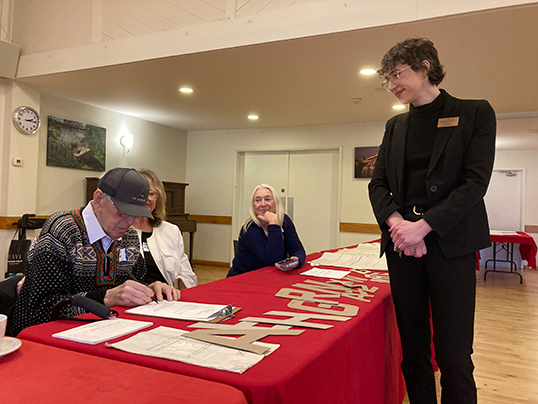
Frostad’s donation includes photographs, boat plans, workbooks with measurements, and stencils used to add lettering to boats. Ceremony attendees were interested in the wide variety of vessel types and purposes.
“It was also interesting to see multiple drawings of one vessel, some coloured, some with interior mutli-level layouts included,” Toft says.
Recognizing Norwegian contributions
When the event’s MC asked the audience to raise their hands if they were boatbuilders, fishermen, or current owners of a Frostad boat, Moses-Coats recalls “all hands” shooting up.
Until MMBC digitalizes this archive, those interested in viewing the Collection can contact the collections manager or the museum’s general email.
“People looking to do maintenance are always looking for plans,” Moses-Coats says. “We get a lot of requests from model enthusiasts who are looking to create scale models of their favourite boats.”
Organizer Toft points out that Frostad’s designs hold significant value for boatbuilders and buyers. She believes the establishment of the Frostad Boatworks Collection has fostered more awareness of the need to “officially document, preserve and make available” artefacts from B.C.’s boatbuilding industry.
“Kris thinks it is important that boat designs be preserved and made accessible,” Toft says. “At this point in time, [that can] only be done by a museum or archive.”
For Toft, the collection also documents the history of Norwegian immigration in Canada. In 2000, Frostad led a team of master boatbuilders and volunteers to create a half-size replica of the Norwegian Viking Ship Gokstad. The ship sailed for 15 years in English Bay and is now displayed at the Scandinavian Centre.
For more information on vessels built by Frostad Boatworks, see www.nauticapedia.ca/Articles/Vessel_Builders_Frostad_Boat_Works.php


Comments will load once you reach the end of the article.