
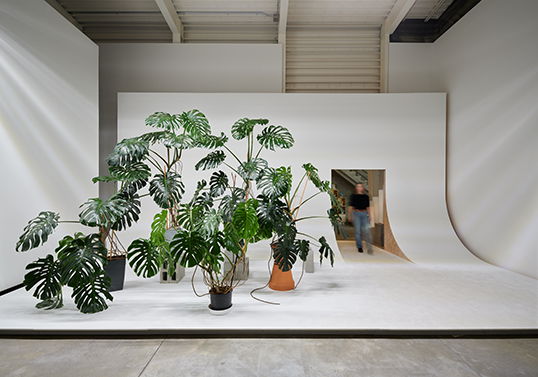
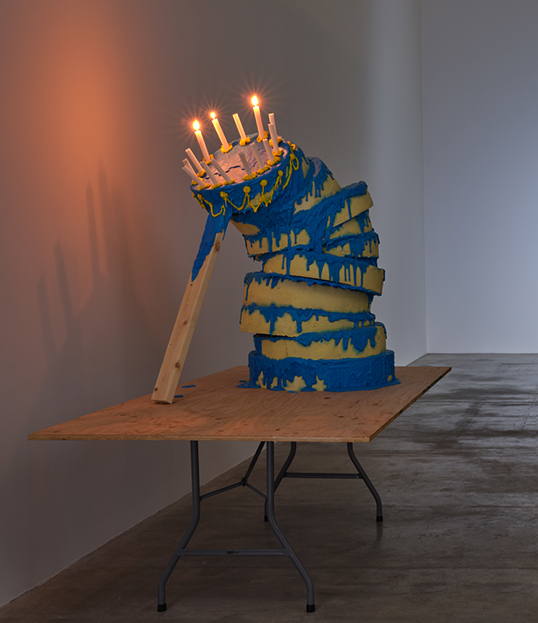
Abbas Akhavan, One Hundred Years (2025), royal icing (confectioner’s sugar, egg whites and food colouring), stainless steel, hardware, oil lamp, paraffin oil, candles and lumber. | Photo by Rachel Topham Photography, courtesy of the artist and Catriona Jeffries
For O’Brian, the exhibition showcases Tehran-born Akhavan’s ability to construct meaning by engaging with both the natural and built worlds – including the Belkin’s architecture.
“The viewer is invited to walk into the gallery from behind a wall, and onto a stage of sorts,” says O’Brian. “[This encourages] viewers to consider their agency in how they see, feel and enable the experience of the exhibition – as well as how they are potentially surveilled.”
Public engagement
For O’Brian, the Belkin’s status as an art gallery on the University of British Columbia’s (UBC) campus provides opportunities to connect with “scholars and thinkers.” Her interactive concept for the exhibit sparks broader conversations rooted in art that span various disciplines.
“Conversive Structures is designed to bring paired scholars from distinct disciplines to reflect on the exhibition from the vantage point of their own academic research,” the curator says. “We approached scholars that we felt would have an affinity to the methodologies and operations of Abbas’s work that queries narrative structures and time.”
The next Conversive Structures event (Nov. 19) will see Cat Prueitt, a UBC assistant professor of philosophy, in conversation with fellow UBC assistant professor Christine Evans from the theatre and film department. The panel, “Politics of Perception: Visibility and Absence,” will explore how ideas of presence, absence and memory are shaped by imagination, perception and representation.
“[They] will consider film and structural narrative forms and a philosophy of time and gathering spaces,” O’Brian adds. “These conversations will be recorded and made available on the Belkin’s website later in the fall.”
Conversive Structures center around the artist’s work that explores representations of time in narrativized spaces.
“[His installations] operate in an open-ended way about the way we construct meaning, engage with the natural and built world and its inhabitants in this moment of climate crisis,” O’Brian explains.
She adds that Akhavan also explores how to read images in today’s “hyper-saturated moment of the visual.”
Behind the curation
O’Brian worked with Akhavan for two years to develop this exhibit, which features many new and “made in Vancouver” works. The pair designed a floor plan reflecting Akhavan’s vision for the exhibit. While the works can be viewed in isolation, O’Brian highlights how they “work in consort” with each other when viewed together.
“The works are arranged to be in conversation with one another across a variety of axes and are paced and placed for viewers also to engage in the meanings held in the spaces between works,” she says. “What connections unfold as you loop through the exhibition? What are the material, scale and metaphorical links between works?”
O’Brian also leveraged the Belkin’s architecture and interior design for the exhibit. She used the gallery’s high ceilings and moveable walls to “allow light and sound bleed.”
“All the works are lit by their own internal logic – grow lights, candles, video monitor glow – and that pulls viewers from one work and structure to the next,” the curator explains.
For O’Brian, these works offer viewers “moments of reflection.” Another part of the curator’s vision is creating a digital and physical space for public engagement with the art pre- and post-visit. The Belkin’s website offers installation photographs, a digital reading room of the exhibit’s themes and a recorded conversation between the artist, O’Brian and artist/UBC associate professor Marina Roy.
“The works allow viewers to project their ideas and experience onto them – like a green screen – and think about how images are constructed, how they move across time and space,” the curator adds.
For more information, see https://belkin.ubc.ca/exhibitions/abbas-akhavan-one-hundred-years/


Comments will load once you reach the end of the article.