
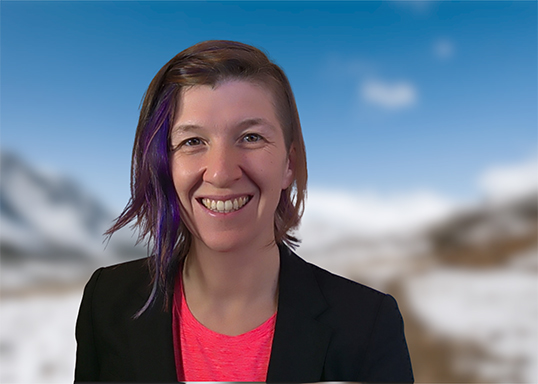
Meaghan MacNutt.
“The gaps that we’ve seen in the exercise physiology research are bigger than have been previously reported in more heterogeneous bodies of literature,” adds MacNutt.
While other studies have examined sports science – which includes exercise physiology in addition to nutrition, training rehab and clinical fields – MacNutt’s study focused on exercise physiology literature.
Underrepresented bodies
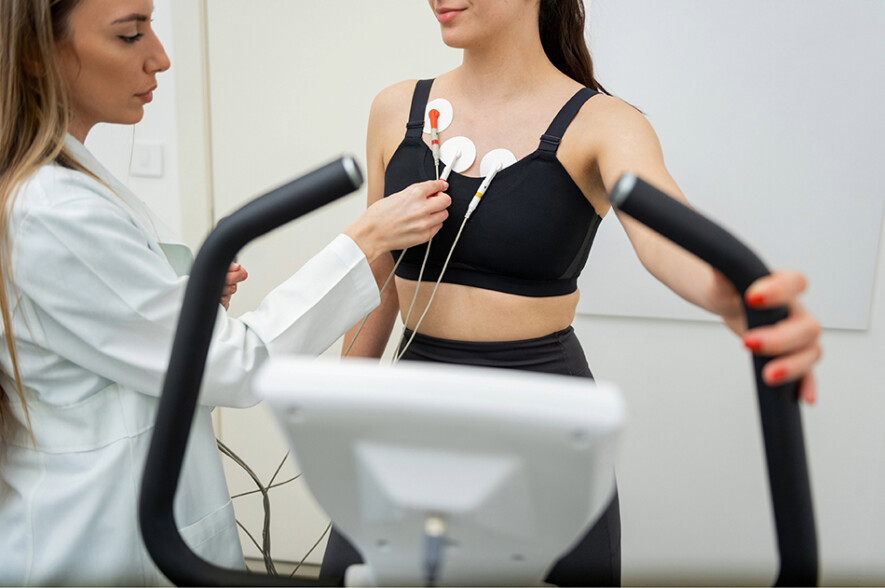
Exercise physiology examines how the body functions when exercising. This includes both a singular instance of exercise and chronic training.
“If you got up right now and started to do jumping jacks, exercise physiology would explain how your body is able to do that,” the professor says. “It also studies: If you do jumping jacks every day for six months, your body adjusts and you start to show training responses, how does your body adjust to chronic exercise and training responses?”
MacNutt’s research identified two different, but related gaps in this field. The first points to fewer female bodies being studied. During their literature review, MacNutt’s team looked for justifications on why researchers excluded the female or male body.
Her team found that researchers were more likely to give a justification when prioritzing the female body. When a reason was given for excluding the female body, it was most often related to sex hormones.
“People are afraid, for lack of a better term, of how complex female physiology can be because of changing cycles and hormones,” MacNutt explains. “We know that those hormones do influence some of the things we want to measure.”
These points of measurement include the cardiovascular, respiratory and metabolic systems. MacNutt recognizes this as a real challenge to researching the female body: One must carefully consider how to approach their study to address these hormonal changes.
“Based on your research questions, do you want to study females that are at a particular time in their menstrual cycle to control for things?” the professor asks. “Do you want to carefully time things so you can study females across various strategic points of their menstrual cycle?”
MacNutt adds that, when done well, these approaches are not only lengthy, but also costly. For the professor, this added time and cost is, however, not a reasonable justification for excluding female bodies.
“The consequence is that we actually don’t know nearly enough about female exercise physiology,” MacNutt says. “We would advocate that, even if it means doing fewer studies, doing higher quality research carefully that includes female participants would be of more value to scientific enterprise and to the public.”
The language of science
Their literature review also examined the language used in scientific papers. It found that scientists often default to the male body as the standard for human physiology.
The female body, MacNutt points out, is “othered” and “separated.”
“Some examples of that would be when there’s a study that’s done only in males, there isn’t likely to be a big deal made of that,” MacNutt explains how these studies don’t usually include the word “male” in the title. “If [the study] is with all females, that is in the title – that is advertised.”
The professor adds, research focused exclusively on males tend to use language like “in athletes,” “in humans” or “in runners.”
“This is a bit harder to unpack and reverse because it suggests that there are really deeply held attitudes, probably subconscious attitudes,” the professor reflects.
Diverse representation of female bodies is also a concern. According to MacNutt, scientific studies may only include participants who aren’t on oral contraceptive pills or those on a “regular” menstrual cycle.
“The females that we’re studying aren’t even entirely representative of the females out in the world,” MacNutt shares.
This bias also shows up in textbooks and other learning materials. Another concern is the lack of women-identifying researchers in this field.
For MacNutt, this is a problem of retention – few women students remain in the field to become academics.
In her team’s study, only 27 per cent of all authors were women. Out of this group, MacNutt adds, “only 16 percent of senior authors are women.”
Next steps
This bias has real-world consequences. Exercise physiology research provides training guidance for elite athletes, such as those competing in the Olympics. It also shapes exercise guidelines for obtaining good health and preventing diseases.
“If we’re basing all those things on data only collected in males, knowing there are sex-related differences, then all the women, the guidelines and policies that rely on those data are misinformed,” MacNutt cautions. “We do have a lot of catch-up to do to make sure that our recommendations reflect everyone.”
The professor also points out that physical activity guidelines for pregnancy were only developed within the last five years.
“When we’re developing these more specific guidelines, we should be making sure they are reflecting what males need and what females need,” MacNutt shares. “We don’t want to assume that things we study in males will apply to females.”
MacNutt recalls learning of this research gap in the late 1990s as an undergraduate student. Guidelines on research equity already exist amongst journals, institutions and funding associations. The problem, according to the professor, is lack of accountability when researchers fail to follow through with their equitable research proposals.
“Our work is not meant to shame or blame individual researchers, it’s more to identify: We have a collective responsibility here,” MacNutt says. “Researchers need to do better, but all these structural checkpoints need to do better too – the journals, the academic leaders, the funding agencies.”
She believes academic institutions could play a bigger role by incorporating equitable research practices into a professor’s tenure evaluation, for example. The professor also hopes to see more conversation about traditionally taboo topics, such as menopause.
“As end-users of the research, the public should have a voice in what they want and what they need,” MacNutt says. “Use your voice as much as possible to advocate for research in and for women.”
For more information, see www.hes.ok.ubc.ca/about/contact/meaghan-macnutt


Comments will load once you reach the end of the article.