
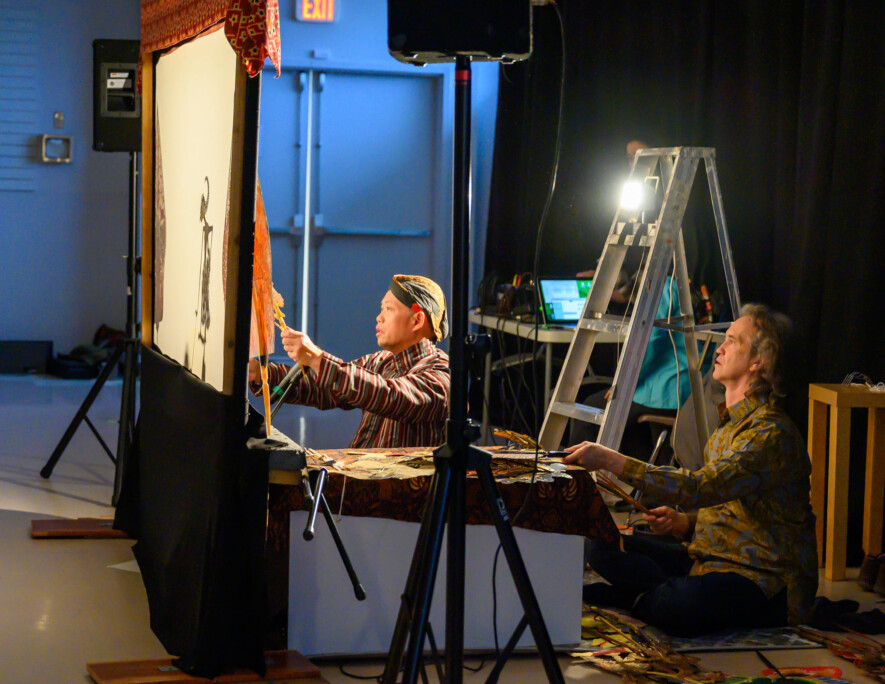
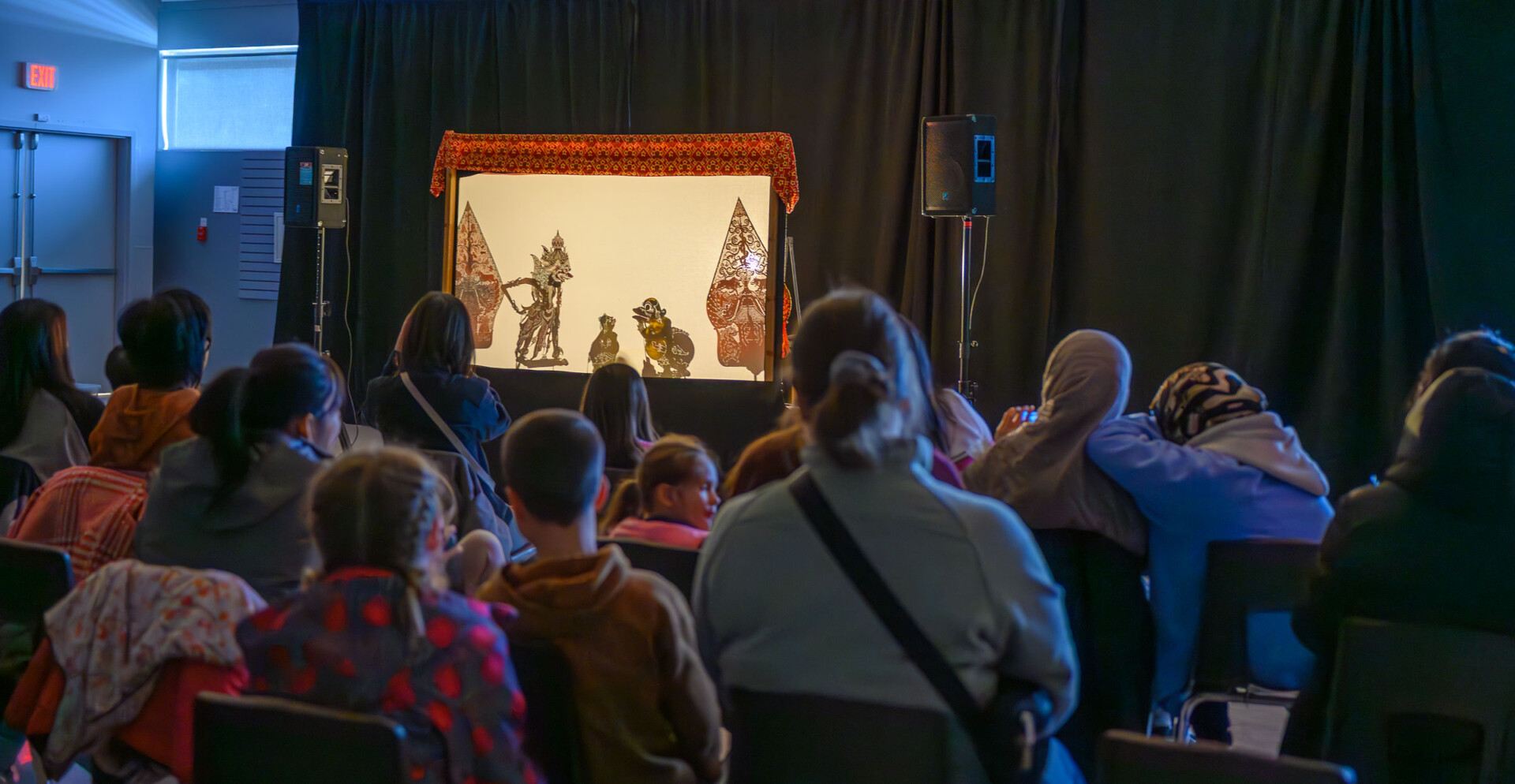
Previous shadow puppet theatre performance at Langley’s Celebration of Culture | Photo by Lisa Geddes; Courtesy of Langley Arts Council.
The Langley Arts Council presents its annual Celebration of Culture at the Aldergrove Kinsmen Community Centre this March—an initiative showcasing the city’s diversity through live performances, workshops and an art exhibition. Arts educator Sutrisno Hartana will lead “Wayang Kulit: Indonesian Shadow Puppet Workshop and Performance” on March 17. For him, the practice of shadow puppetry is not only an art—it is a way to build communities.
“Younger kids might not know the cultural traditions from other countries, and it’s very important [for them] to learn,” Hartana says, adding the world is now interconnected. He encourages everyone to learn about other cultural traditions.
During the workshop, participants can choose how they wish to learn about Wayang kulit—including making puppets or developing narrations.
The art of puppetry
The tradition originates from the Indonesian Islands of Java and Bali. Wayang Kulit has been inscribed in the UNESCO’s list of the Intangible Cultural Heritage of Humanity.
“It involves language, poetry and prose—it’s a form of storytelling,” Hartana says, adding the puppets can communicate in different aspects, including through a visual form. “The shadows of the puppets create beauty.”
Born to a Javanese family of artists, Hartana was exposed to shadow puppet theatre at an early age. As a child, he would sneak out in the middle of the night to watch these performances.
Choreography and dance are also part of the show. According to Hartana, these various elements progress the narrative—blending music, visual image, characterization and theatre into one performance.
Wayang kulit usually tells stories from the Mahabharata and Ramayana traditions—epics with Hindu and Buddhist roots. The topics include the kingdom and army with characters like the king, princess, and hero.
These narratives were brought to Southeast Asian countries—Malaysia, Indonesia and Thailand—from India, Hartana adds.
“In the contemporary aspect, many different narrations, visual images and stories related to the modern era can be included as well,” he says.
Other forms of puppetry use two handles: one on the puppet’s head, another on its body. Wayang kulit uses three handles, allowing the puppeteer to focus on communicating through gestures.
“We put the main handle on the body, and two different sticks can be put on two different hands,” Hartana explains. “People will move the hands to develop communication [through] movement and gesture.”
A socio-cultural practice
Puppeteers are called, dalang. While general discussion on the script and props occurs before the show, dalangs perform largely through improvisation—responding to audience reactions.
“He develops narrations, gives characters voice, and sometimes the puppeteers are also required to sing a good song and describe the situation,” Hartana explains.
Audience engagement—especially call and response—is a major part of shadow puppet theatre, adds Hartana. The source of light, usually placed above the puppeteer’s head and projects shadows on a screen, also plays a key role.
“In Javanese performing arts, we usually use complete sets of Gamelan,” Hartana says of traditional performances. Gamelan is a traditional Javanese musical ensemble—composed of percussion instruments.
For the upcoming workshop, Hartana has prepared a recording of Gamelan music. He sees the workshop—and subsequent performance—as a more “intimate” experience.
As Hartana brings participants into the “imaginary” world of shadow puppets, they are encouraged to develop ideas into a performance. Some could work on narration; others could work on manipulating the puppet. Performance is not required.
For the arts educator, Wayang kulit allows people to express themselves through puppets, communicating messages to an audience. This social-cultural aspect of the performance builds connection and confidence.
“How should people manage themselves and not get easily influenced by these tensions?” Hartana speaks of today’s world. The answer, for him, lies in shadow puppetry.
Aside from the Langley celebrations, Hartana—along with special guest artists from Java, Indonesia— will present a Gamelan and Wayang Shadow Puppets Performance-Workshop on April 7 at Simon Fraser University’s School for the Contemporary Arts.
Langley’s Celebration of Culture 2026 also includes the My Heritage Exhibition (Main Hall Gallery, March 5 to April 28); live music performance from the BC Chinese Chamber Ensemble (March 26); Polynesian dance performance from Spirit of the Pacific Cultural Society (March 28); and a traditional Vietnamese pho cooking workshop (March 19).
For more information, see https://www.langleyarts.ca/events/coc


Comments will load once you reach the end of the article.