
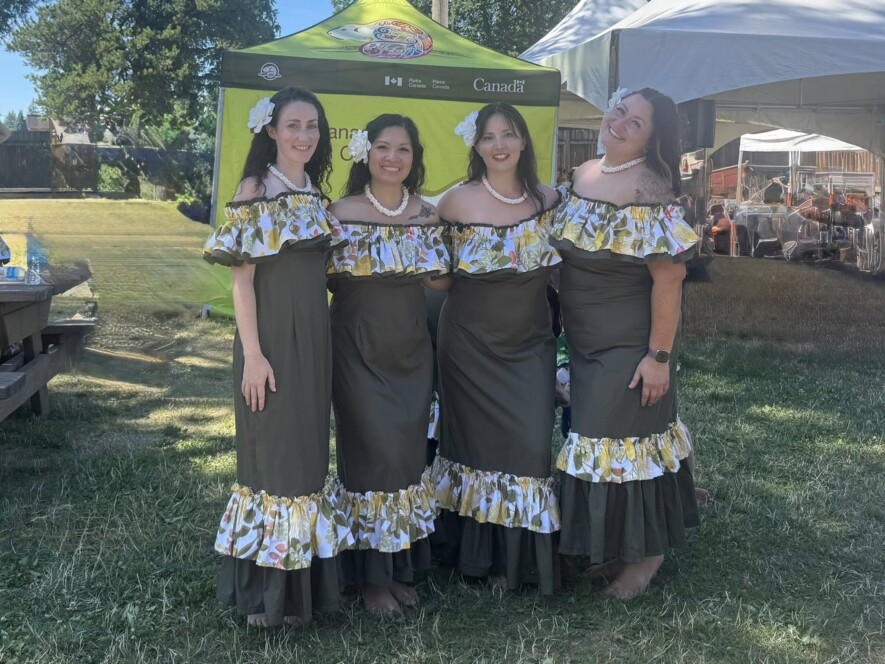
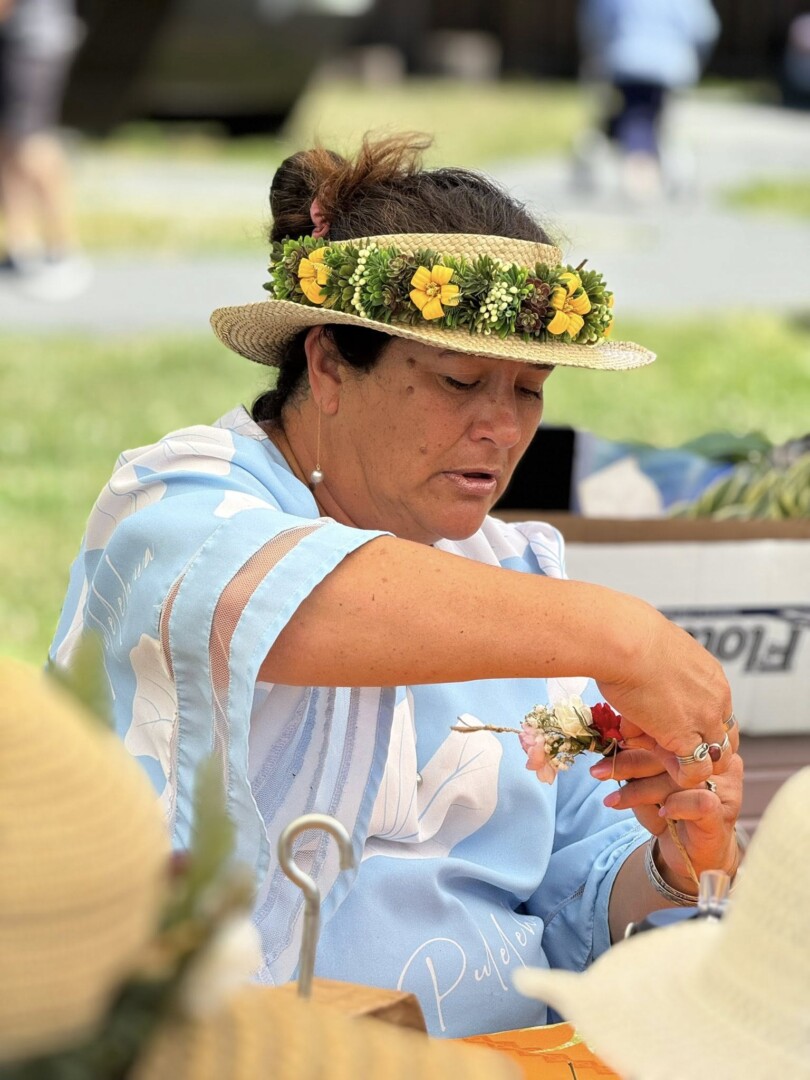
Previous HMA celebrations | Photo courtesy of The Spirit of the Pacific Cultural Society.
The Spirit of the Pacific Cultural Society presents Hoʻopili Me Ke Aloha (HMA) Cultural Festival on July 11 and 12 at the Fort Langley National Historic Site. Jessica Hokulani Demos, executive director of the Society, says the festival celebrates both Polynesian and Indigenous cultures—creating cultural exchanges built on connecting, sharing and learning.
“Hoʻopili Me Ke Aloha means to connect with love,” Demos says. “By sharing our music, our crafts, and our histories side-by-side, we’re helping people walk away with a deeper respect and understanding for one another.”
Respectful sharing
The festival features cross-cultural storytelling with traditional Hula and Tahitian dancing/drumming, along with live singing/drumming from the Katzie, Squamish and Shuswap Nations. A guest performance from Hui Hula o Saltspring—the direct lineage of 19th century Hawaiian pioneer families in B.C.—will also take place.
“Local legend Auntie Kate Roland, and Squamish First Nations artist Tʼuyʼtʼtanat-Cease Wyss will be back talking about their own Hawaiian and Indigenous family histories,” Demos adds.
Attendees can also enjoy an Indigenous Peoples Artisan Market featuring local vendors. Indigenous governance scholars and cultural connectors from Hawai’i and the University of Victoria will also be in attendance.
“We are so happy to have our cultural artisans back from Maui doing coconut leaf weaving and lei making masterclasses and demos,” the executive director says these community opportunities break the performer-audience barrier. “We have free, interactive spaces right on the grass where anyone can join a drum circle, take a quick language lesson, or try an introductory hula or Tahitian dance class.”
These offerings, Demos emphasizes, move away from stereotypes; it’s not about “putting on a show” and presenting a Hollywood-version of cultures. Instead, HMA welcomes people “into the real story.”
“We don’t just teach dance moves; we teach our students the language, the history and the responsibility behind songs,” Demos adds. “When you know the deeper meaning, it stops being passive entertainment and becomes real cultural preservation.”
Demos adds that, the festival lets communities speak for themselves—which is central to moving away from stereotypes. At their dedicated panel sessions, the public is encouraged to listen, share and ask questions about “what it means to carry cultural identity today.”
A continuing lineage
HMA is also grounded in the local history of Native Hawaiian fur traders living and working alongside local Coast Salish First Nations during the 19th century. Intercultural marriages also occurred.
“In 1831, Kānaka Maoli, the native Hawaiians, made up 15 percent of the men employed at Fort Vancouver,” Demos adds. “By 1844, the number of Kānaka Maoli based at Fort Vancouver increased to 43 percent of the men employed there, and employment peaked around 1846 when 119 Kānaka Maoli worked at Fort Vancouver.”
Demos points out that, in 1825, a group of men were sent to establish Fort Langley; amongst them were “two of the longest serving Kānaka Maoli in the fur trade,” Como and Peeohpeeoh.
“[Their] ancestors remain in the area today,” she adds. “Kānaka Maoli had similarities to Indigenous Nations, a different worldview to their employers.”
Demos adds that, Native Hawaiians, like Canada’s Indigenous groups, were not treated kindly. They did not enjoy the “same privileges” as other Hudson Bay Company employees.
“Ships would stop to rest to buy provisions and restock crews, and Kānaka Maoli were valuable deckhands at a time when few other sailors actually knew how to swim,” Demos explains how Hawaiʻi became a major port. “Hawaiians lived in the sea, swam every day, and they saved a lot of lives with their swimming ability.”
Demos shares that, at the time, Hawaiʻi was facing major changes—including the breakdown of their religious and legal system known as kapu. Western contact, she adds, also caused major crises, leading to the “near-death” of their culture.
These challenges resulted in Hawaiians leaving the islands in search for better opportunities. Many ended up in the Pacific Northwest, living alongside its Indigenous peoples.
“I find it so interesting how these Indigenous Peoples from different lands—Polynesian islands and North America—can have so many similarities; between our beliefs, our origin stories, our relation to the land, our practices, our way of life, even our art and music,” Demos says this connection is both “beautiful” and “powerful.”
For more information on The Spirit of the Pacific Cultural Society, see https://www.spiritofthepacific.ca/.
For more information on Hoʻopili Me Ke Aloha 2026, see https://www.spiritofthepacific.ca/hma-26.


Comments will load once you reach the end of the article.