
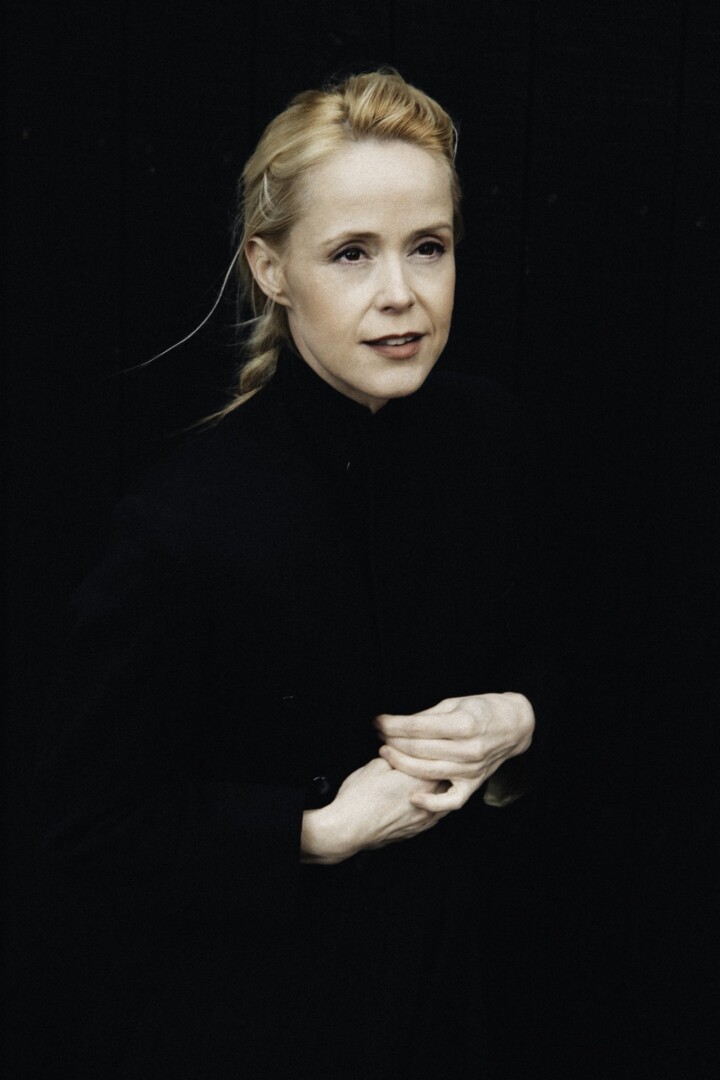
Tina Dico | Photo by James Hole.
My writing process involves conversing with “a fictional listener”—a conversation that searches for mutual agreement, says Danish singer-songwriter Tina Dico. These points of agreement, she adds, could be a shared “emotional or existential truth.”
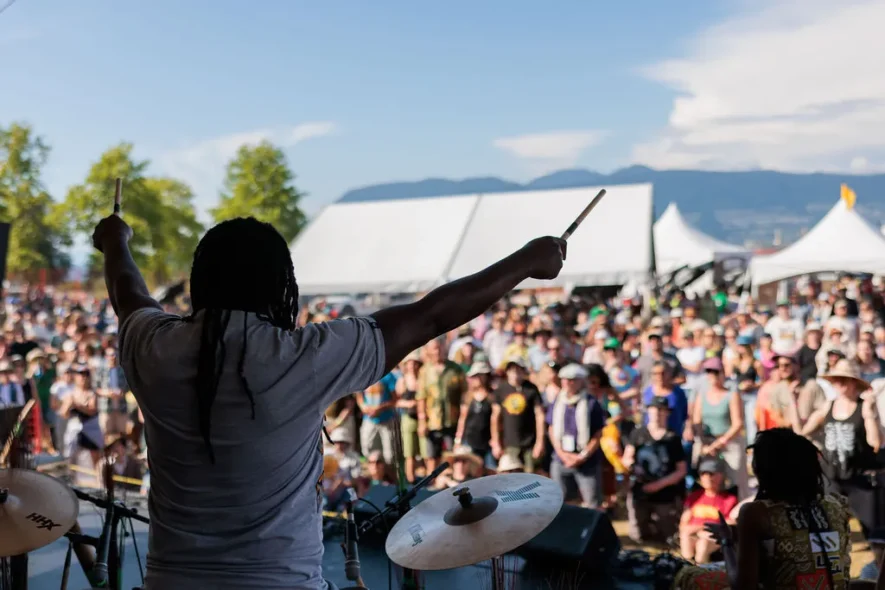
Dico (vocals, guitar, drums) will perform with her partner and collaborator Helgi Jónsson (vocals, guitar, piano, trombone) at the Vancouver Folk Music Festival on July 18 at Jericho Beach Park’s South Stage. She will also take part in that day’s Stories From Across the Pond (South Stage) programming and perform a short set on the festival’s opening night (July 17, Main Stage)
“One of the things we enjoy most is to sing together, and that’s quite a big part of the show: our voices,” she adds. “Helgi has a crazy voice: sometimes he’s below me, sometimes high above, and then, his main instrument is the trombone which is also such a great addition to the girl-with-a-guitar-vibe.”
Freezing time
Foot drums are part of Dico’s repertoire of instruments—all of which, she says, takes audiences to different musical places, including soundscapes that are fragile, quiet and massive.
“We’ll play songs from different parts of my catalogue and see where they take us,” Dico adds. “After playing together for so many years, anything can happen!”
Dico—who didn’t plan on becoming a musician—started writing songs to “freeze” moments of her life. With songwriting, she could “sit quietly” with these frames of time, allowing them to be examined and processed.
“I can go inside the song and study a thought, a feeling, a relationship or a contradiction for as long as the song lasts,” the musician explains. “And each time I come to it, I might discover a new layer or see it from a slightly different distance.”
Songs, Dico says, don’t object to what one puts inside of it. They even welcome contradictions.
“You can say, ‘I love you. I don’t love you,’ [and] that kind of contradiction is completely at home in a song,” Dico reflects. “It creates a space where you can examine yourself and your life without judgement and without hard edges.”
She usually begins writing with a sentence—one that feels as though “it could unlock something,” be it a feeling, theme or a “new way of framing something.”
“I’ve often mistakenly thought I understood where my inspiration comes from,” she reflects. “Then, sometimes it disappears, and I think, ‘Where did it go? What an absolute mystery this is!’”
What a word can do
Dico works in both English and Danish. The difference, she says, lies in each language’s treatment of words.
For her, Danish words feel bigger and heavier. They also appear to “carry more imagery”—with each word embodying a story that develops upon meeting a listener.
“You can use a word like ‘kærlighed’ (love), ‘stopklods’ (an obstacle that blocks you) or ‘cykelstyr’ (bicycle handlebars), and in Danish, the word itself already feels like a story or a choice,” the songwriter explains. “It makes you think, ‘Oh, that’s an interesting way to put it.’”
Similar words, Dico observes, may go unnoticed in the English language. For her, English words—which are “lighter and more fluid”—don’t embody “as much of the story on their own.”
She adds that, while individual Danish words offer humour, associations, history and “a certain almost clumsy physical weight,” English words are different.
“They don’t get in the way,” she describes anglophone vocabulary. “The words can weave themselves into the melody and let the emotion come through the song as a whole rather than through each word.”
Despite this close attention to language, Dico sees her music as largely international. In fact, much of her career has been spent working outside Denmark.
“I suppose my music is more up-close and structured, like my country,” Dico reflects on how her Icelandic husband’s music resembles Iceland’s nature. “Denmark isn’t wild or dramatic—it’s cultivated, understated and quite orderly, and there’s a certain restraint.”
She recognizes the same sentiment in her music, where even big emotions are approached quietly.
New beginnings
The musician has long identified with being an observer—an experience that has made life “feel very meaningful.” When songwriting, she decides, from these observations, “where something begins and ends,” what should be included or left out, and other details that compose stories.
Dico is currently working on a new album—one described as “relaxed, played, honest and clear.” Her first recordings involved sitting in front of a microphone, accompanied by her guitar and a drummer.
“Lyrically, it is no longer a woman searching high and low for something, as it often was in the past,” the musician adds. “It is a woman who has found what she was looking for but is now trying to stay connected to it: to protect it, enjoy it and live inside it.”
Strings were also incorporated early in the recording process—a new experience for Dico. Since having children, Dico’s touring experience has changed. Previously, she could retreat into her “own little poetic Tina-universe.”
“With kids, every day has to have something wholesome and grounding: good food, connection, conversation and play,” the musician shares her fondness for these changes. “Now I go on stage as a whole person, with everything that I am—Not just an artist whisking through town.”
Dico lives for moments on stage where “a song gets wings,” connecting everyone in a feeling of togetherness. This sensation, she adds, can even be created in moments of silence between words.
“There is often a melancholy in [folk] music that really resonates with me,” the musician adds that folk festivals feel like communities. “There is no hype and no chasing the latest trend. Just songs and real instruments that connect people on and off stage.”
Dico grew up listening to Scottish and Irish folk traditions—songs that connect her to previous generations. Bob Dylan, Leonard Cohen and Tracy Chapman are other influences.
“[My father] played me a lot of music that was skilfully and perfectly recorded, but I found myself drawn to the songs more than anything else however they happened to be recorded,” she recalls him having a “proper listening room” with speakers and other high-end equipment. “A rough recording of Dylan’s voice and guitar, with a song full of urgency and story, was all I needed.”
For her, a song’s power is its ability to be kept for a lifetime: one cannot lose or break a song, nor can it be taken away.
“Once you’ve taken a song into your heart, it stays there,” she shares. “You can pull it out years later and let it remind you where you’ve been, who you were, and [it] lets you measure the distance between that person and who you are today.”
The 49th annual Vancouver Folk Music Festival (VFMF) returns July 17 – 19 at Jericho Beach Park. Visit the festival’s website for the full line-up.
For more information on Tina Dico, see https://tinadico.com/.
For more information on VFMF 2026, see https://thefestival.bc.ca/.


Comments will load once you reach the end of the article.