
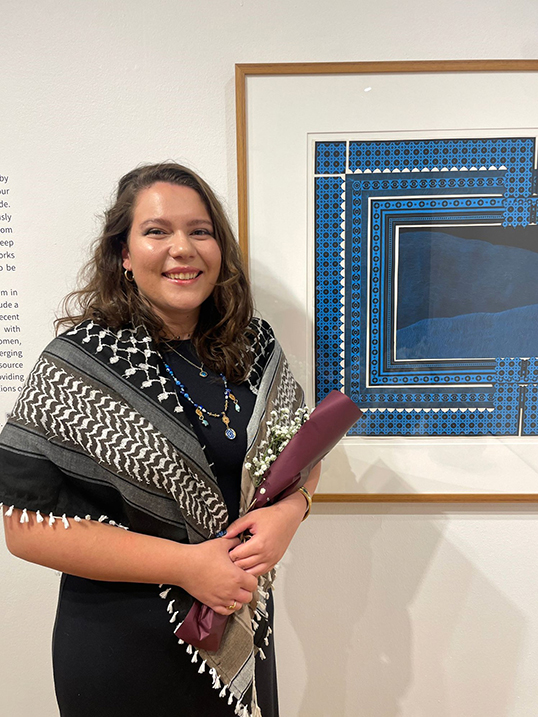
Through Struggle. | Photo courtesy of Rawan Hassan.
Passed from mother to daughter for generations, it is now being passed from Palestine to the rest of the world. In addition, interdisciplinary visual artist Rawan Hassan has challenged the craft to question the notions of Palestinian identity.
According to the artist, many crafts either become lost or are unable to evolve organically due to colonialism. That is why Hassan’s focus is experimenting and playing with tatreez to emphasize Palestinian futurism.
“I don’t think there’s one definition that fits into terms of what is the Palestinian identity,” says Hassan. “There’s so many interpretations and understandings and lived experiences within that.”
Hassan and other artists will be showcasing their latest pieces in the upcoming exhibition RESIST! at the Burnaby Art Gallery from Sept.11 to Nov. 15.
A mosaic of memories
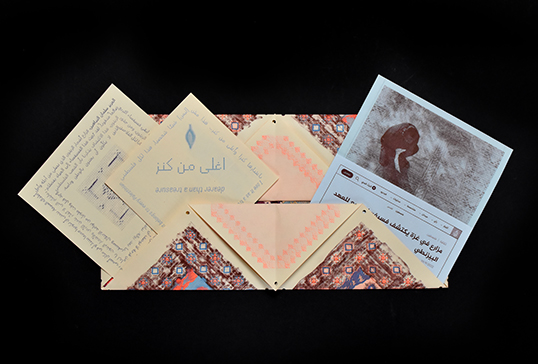
Entitled “اغلى من كنز” or Dearer than a treasure, Hassan’s exhibition is an artbook that is “specifically exploring tatreez”. But the discovery in 2022 of a Byzantine mosaic by an olive farmer, Salman al-Nabahin, has given added significance to the ancient craft.
“I see it as a treasure, dearer than a treasure,” al-Nabahin was reported to say after uncovering the mosaic. “It isn’t personal, it belongs to every Palestinian.”
In Hassan’s artbook, al-Nabahin’s sentiments on a shared, communal relic are embodied in the animal motifs inspired from the Byzantine mosaic, as well as slogans of liberation and motifs of seeds that represent growth and resilience.
“Through our research, we found a lot of institutions were keeping up to date with the current status of the mosaic itself while the genocide was ongoing, but there were no updates on [Salman] and his family… In the artbook, we dedicated a letter to him, acknowledging how these institutions have erased him from the equation.”
Transcending the traditional
Growing up in a household with tatreez shining on the walls, Hassan loved to experiment with her ancestral craft. “There’s a lot of really talented Palestinian tatreez artists who are quite heavily involved in preserving the practice,” she says.
Her artbook, she adds, is an exquisite example of Palestinian futurism. She sewed the original embroidery, adding watercolor and rubbing charcoal to make the tatreez resemble the Byzantine mosaic. Then she had the tatreez scanned and printed from a risograph.
The artbook itself consists of diamond-shaped embroidered pieces and other parchments which all act like a jigsaw puzzle where you must connect the “tiles” of embroidered mosaic into a whole. It explores what it means to create art and culture, “not only as a diasporic Palestinian but as like a direct relationship with what’s happening back home,” says Hassan
Threads across time and space
“If you look at the experiences of a Palestinian living in Gaza, a Palestinian in Jerusalem, a Palestinian in the West Bank, or in the neighboring refugee camps… there really isn’t any one definitive way to define the Palestinian identity,” says Hassan. “But I think [Salman’s] words are the root of our collective effort towards the Palestinian struggle.”
Dearer than a treasure engages people in honest dialogues of anticolonialism and anti-apartheid that are the hallmarks of Hassan’s advocacies. “We wanted to explore that notion of what it means to collectively hold an identity and have that pluralist sense of identity in relationship to land and objects,” says Hassan.
For her, the Byzantine mosaic is the perfect example of how Palestinians existed before the occupation, and how they shall continue to exist long after.
“And making the firm statement that this is our home, this is our homeland, and we are the indigenous people of that land,” Hassan emphasizes.
For more information visit: www.burnaby.ca/node/9801


Comments will load once you reach the end of the article.