
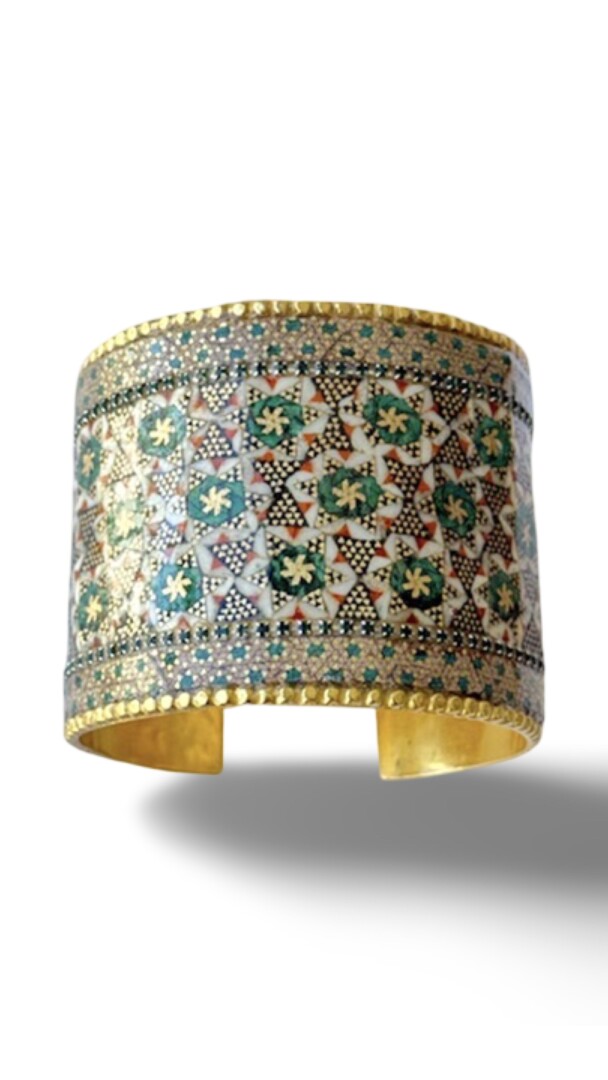
Handcrafted Khatam art by Laleh Javaheri. | Photo courtesy of Laleh Javaheri.
Cultural geometric shapes or patterns influence artists: Laleh Javaheri, Rojin Habibi and Jamie Carlson.
“Art enriches life – it brings reflection, joy and meaning,” says artist and designer Javaheri. “Events like this remind us how essential creativity is to the human experience.”
This 29th edition of the Crawl has expanded to 20 new buildings. It is also the start of a three-year partnership with the Audain Foundation.
Modernizing ancient art
Jewellery is a more intimate form of art – one that becomes part of someone’s personal story, says Javaheri. Her latest Khatam jewellery collection will be displayed at the Arts Factory (Suite A, 281 Industrial Avenue) this Crawl.
Since 2022, Javaheri has been reviving Khatam, a traditional Persian art of inlaying, through her jewellery creation.
“[Jewellery] is sculpture in miniature, something that interacts with the body and becomes part of someone’s personal story,” she adds. “Like all art, it carries emotion, meaning and craftsmanship, but it also moves and lives with its wearer.”
Khatam connects the Tehran-born artist to her cultural roots; it also reflects her values of “patience, precision and beauty.” An interdisciplinary artist, Javaheri has also explored painting, sculpture and textile arts – with each discipline offering new ways of thinking.
She learned about colour through painting; form through sculpting; texture through textiles; and precision as well as scale through jewellery design.
“[My artistic language] is a blend of tradition and modernity – precise yet emotional, rooted in heritage but expressed in a contemporary way,” Javaheri shares, adding that the principles of harmony, balance and simplicity guide her jewellery designs. “I want each piece to feel timeless, well-crafted and emotionally resonant.”
For Javaheri, the Crawl is an opportunity to celebrate art and its community-building benefits. Participating in the Crawl for the 10th time, Javaheri looks forward to sharing the togetherness of her traditional techniques and the studio’s modern setting.
“[Khatam] is traditionally used to decorate wooden surfaces such as jewelry boxes, frames and musical instruments,” she explains of the ancient art form. “It involves arranging tiny pieces of wood, bone and metal into intricate geometric patterns, often with hundreds of elements in a single square inch.”
The artist is designing a new jewellery collection. This one takes inspiration from Persian architecture’s domes and arches – imagery that is central to her passion for the arts.
“I’ve always known I wanted to be an artist,” she reflects. “My inspiration came from growing up surrounded by Persian art and architecture – the beauty of patterns, geometry and harmony fascinated me.”
Recognizing Kurdish identity
“My nose is here to stay,” says Kurdish Canadian artist Habibi.
One of the artist’s favourite creations is a sterling silver pendant titled “The Kurdish Nose.” Habibi welcomes crawlers to her workspace at Shady Acres Artist Studios (Suite 25, 1235 East Hastings Street).
“[‘The Kurdish Nose’] uses my own nose as reference as protest to the plastic surgery culture in the Middle East,” she shares.
She adds that the work also affirms her identity as a Kurdish woman despite pressures to assimilate.
Habibi has always resonated with the creative field: she recalls sewing her first project at the age of seven. She started professionally pursuing the arts, including her jewellery design, after dropping out of university during the pandemic.
“I find that I value aesthetic over function,” the artist says. “I play with space, harmony and am inspired by geometric shapes but still have soft and playful touches to my jewellery.”
Habibi sees jewellery as art: just as one decorates their house with artistic pieces, people decorate their bodies with jewellery. While she started her design journey by working with beaded jewellery, Habibi soon sought to break this method’s limitations.
“With metalsmithing, truly, there are [no limitations] once you fully learn the trade,” she shares. “Watching the metal flow, forging, manipulating the metal in any way; it feels like a connection to my body.”
The artist is currently working on two main projects: the first is a collection of stamped rings reflecting her thoughts inspired by a previous relationship. The second is a bronze sculpture depicting Rio Theatre’s neon sign – it showcases her love for small businesses and arts in East Vancouver.
“The Eastside Culture Crawl brings people and community together which is very integral and needed,” she adds. “It helps keep the beautiful artistic culture of East Vancouver.”
Habibi shares that “The Lines of Kurdistan” – a sterling silver hollow ring – is another memorable piece of her creation. The ring includes an 18K plated engraving of the Kurdish mountain range. The image that inspired the piece was taken from a family photograph.
“The Kurdish proverb ‘No friends but the mountains’ signifies the Kurdish people’s resilience to genocide and trauma,” Habibi adds. “I’m Kurdish; my work is Kurdish; it is not Perisan, it is not simply ‘Middle Eastern,’ nor is it Arab.”
Blending cultures
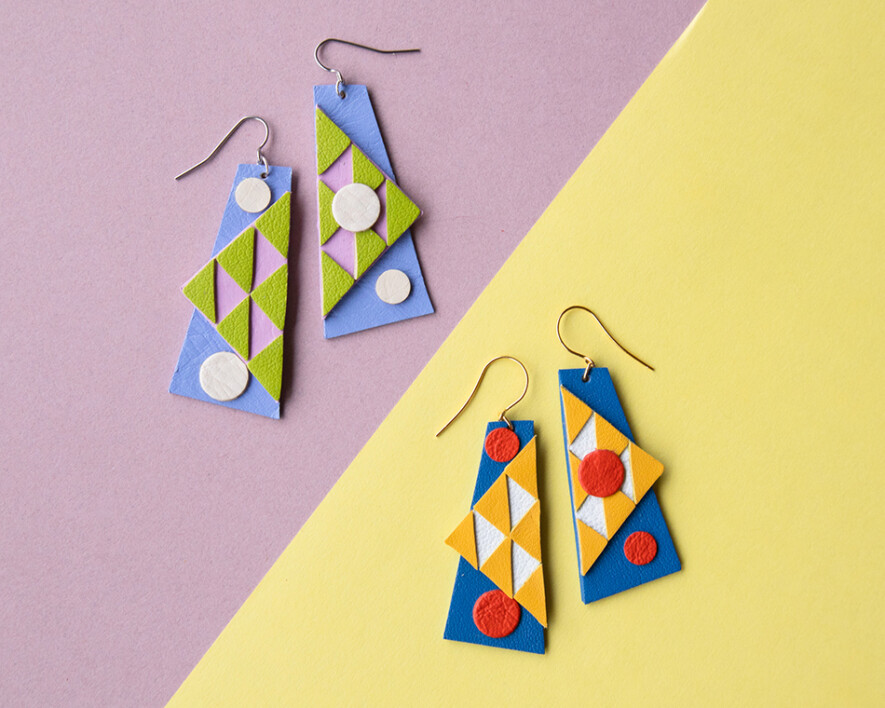
Carlson of Scandinazn (Scandinavian x Asian) invites visitors to her Chinatown workspace, Gore Studio (617 Gore Avenue), this Crawl season. The designer created Scandinazn in 2012 – a celebration of her Swedish and Japanese heritage.
“I’m inspired by the simple geometric shapes and fun prints we often see in Scandinavian design,” Carlson says, adding that her Swedish side serves as the base of her designs. “I get inspired by more literal references from my Japanese heritage, such as traditional prints or motifs.”
Carlson originally dreamed of becoming a fashion designer. Her interest in sewing led to a Fashion Design and Technology degree from Kwantlen Polytechnic University. During her studies, she found a passion for upcycling leather – which eventually led to her jewellery creation.
“Scandinazn came around as a result of playing with second hand leather and getting good at making leather fringe earrings,” the artist says, adding her designs balance shape, colour and proportion.
This will be Carlson’s second time at The Crawl – an experience that she sees as “a real treat.” The artist is used to bringing her designs to markets; the Crawl flips this script, encouraging visitors to seek out artists in their usual space.
She sees some of her work as accessories; others as “wearable art.” For her, the wearer’s choice is what separates accessories from art.
“If you put together an outfit and reach for a pair of earrings to compliment the outfit, I think that pair of earrings is an accessory,” she explains. “But if you reach for a pair of earrings that you want to feature and style an outfit around, I think you’re wearing those earrings as a piece of art.”
The artist is currently working on a new collection, set for release in the next few weeks. The collection will be showcased at this year’s Crawl and her holiday market appearances, including at the indie craft fair, Got Craft, and East Vancouver’s Krampus Markt.
“One of my oldest and most quintessentially ‘Scandinasian’ designs are my Origami Earrings,” Carlson shares. “[They] are geometric polygon shapes, fragmented into pieces and decorated with traditional Japanese patterns.”
The Eastside Culture Crawl involves jewellers, painters, sculptors, furniture makers, weavers, potters, photographers, glassblowers and more.
For more information, see www.culturecrawl.ca


Comments will load once you reach the end of the article.