
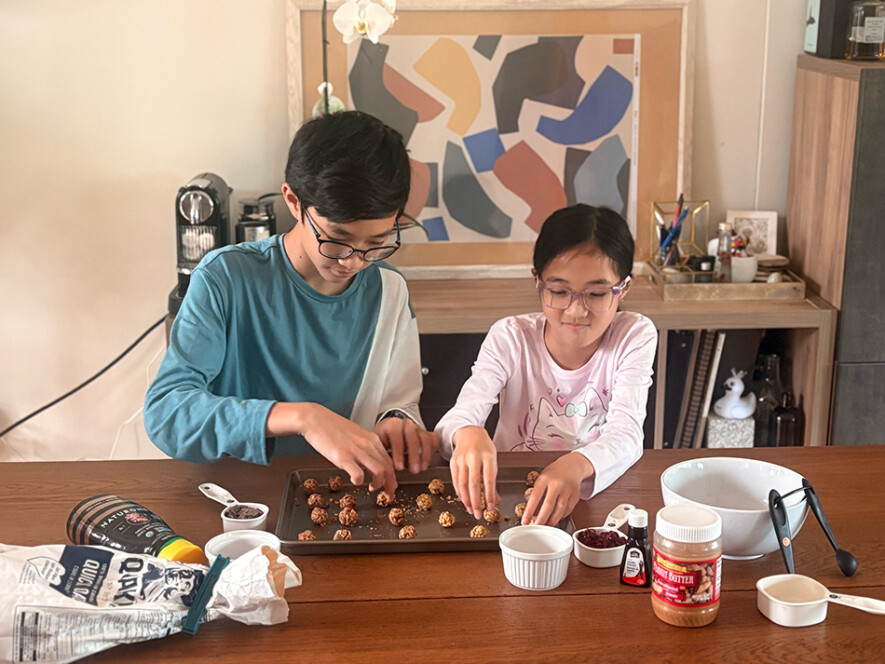
“Mealtime is a connecting and learning time, for example, to share recipes and measure things, to elaborate on the grocery list, [to cook] in the kitchen together with kids – there’s so much learning in that,” says Kehler. “What matters is learning together.”
Family Literacy Week originated from ABC Life Literacy Canada’s national Family Literacy Day initiative. Since 1999, the day has occurred annually on Jan. 27, drawing attention to the importance of family-based literacy activities.
Starting at the table
This year’s theme emerged because food is one of the few daily routines still shared in many families – including those with newcomers.
“If people are coming together over food, it’s a natural time to communicate and share stories,” Kehler notes. “Often that’s when the phones and computers are put away, and there’s space for real conversation.”
For Kehler, mealtime learnings provide opportunity to use real-world materials, such as a grocery store flyer or newspaper ad. Engaging with these materials and the sharing of meals itself provide space for developing “foundational literacy skills”: talking, reading, listening and problem-solving.
“It is a time where we connect and recognize the importance of doing things together as families, and how together, we can have fun and learn skills to read and write,” the program manager says, adding caregivers who aren’t the children’s biological parents are included in this community.
A common concern, Kehler shares, from immigrant parents – for whom English is not their first language – is the fear that they cannot support their children’s English literacy skills. In reality, this idea is a misconception.
“We tell parents, ‘You are already doing literacy,’” Kehler explains. “If you can read and write in your own language, that knowledge transfers, because literacy skills apply across languages.”
Kehler’s perspective is supported by research in language acquisition: Children who develop strong skills in their mother language often acquire additional languages more easily.
“Studies show that children learning two languages often have a larger vocabulary overall,” she adds. “It actually pushes them ahead of the curve and they also become like their parent’s teachers.”
Mealtimes offer countless low-pressure ways to build literacy in both English and the family’s mother tongue. Activities like reading grocery flyers and product labels – even comparing product prices – can build vocabulary and comprehension. Families can also practice naming foods in different languages.
“You can say, ‘This is what we call it in English, and this is what we call it in our mother language,’” Kehler explains.
A powerful tool
Talking about the origins of recipes is another supportive activity. The act of cooking itself also introduces numeracy and sequencing skills, allowing children to develop literacy-adjacent knowledge..
“It’s reading, but it’s also math and planning – figuring out what comes first and what comes next,” Kehler says of activities like measuring ingredients or timing how long it takes to cook a dish.
Decoda Literacy Solutions offers family literacy programs across the province, including IPALS (Parents as Literacy Supporters in Immigrant Communities). The program provides strategies for families to support their preschool and kindergarten-aged children’s literacy development.
“Parents learn practical strategies they can use at home, then they practice them with their children,” Kehler explains.
IPALS responds to families’ cultural and linguistic needs. It aims to help families smoothly transition their children to school. According to Kehler, the results are powerful: children experience increased confidence and are better prepared for school.
Parents, too, experience feelings of empowerment and confidence in their role as their child’s first teacher.
“It’s very reciprocal: We are teaching each other, we want everybody to participate,” Kehler says. “If language is the barrier, let’s tear down that barrier, no one is alone and we need everyone.”
Kehler’s organization, in partnership with Camosun College, oversees publication of The Westcoast Reader, a plain language publication designed for newcomers and learners from all life stages. Articles are adapted from current news into different English language levels.
“It’s a great resource, and they’re real stories about things we’re all thinking about,” Kehler explains. “It helps people build English reading skills without struggling too much.”
It has been in publication since the early 1980s. Kehler sees the publication as another tool for reciprocal learning.
“You read together, talk about the news and bring in your own life experience,” she says. “That reciprocal learning is incredibly powerful.”
An everlasting community impact
Family Literacy Day/Week brings together schools, libraries and community organizations to rethink popular understandings of literacy. For Kehler, literacy is more than just reading and writing – it also involves communication.
“It’s about participation and being able to thrive as a community member,” Kehler adds. “It’s about navigating our world and understanding what’s happening.”
Literacy looks different depending on the child’s age. With babies, it may be naming food or singing songs. Toddlers can talk about colours and textures.
“A lot of early literacy is play-based,” Kehler adds. “It doesn’t feel like learning, but it’s setting kids up for success.”
Preschoolers, in particular, learn through play, while school-aged children can start reading recipes and writing grocery lists. Family Literacy Week events reflect Kehler’s philosophy of supporting families in an accessible and culturally inclusive manner.
In Chilliwack, the Bob Chan-Kent Family YMCA, along with other services providers, will host “The Stories that Connect Us” (Feb. 7) – a free event featuring storytime, music-making and physical activities. The Surrey Libraries Expo (Jan. 31) is another free event showcasing Surrey Libraries’ educational offerings, such as their Mobile Library.
The South Vancouver Neighbourhood House is also hosting an event with storytime and activities at Vancouver Public Library’s Fraserview Branch on Jan. 27.
For Kehler, the most important thing is to “break down barriers such as language” and advocate for inclusion.
“Literacy is a big part of that,” she says. “If there is more equity, inclusion and diversity in our communities, and more people participating, all of us will benefit learning from each other.”
For more information about B.C.’s Family Literacy Week, see www.decoda.ca/get-involved/family-literacy-week
For more information about The Westcoast Reader, see https://www.thewestcoastreader.com


Comments will load once you reach the end of the article.