
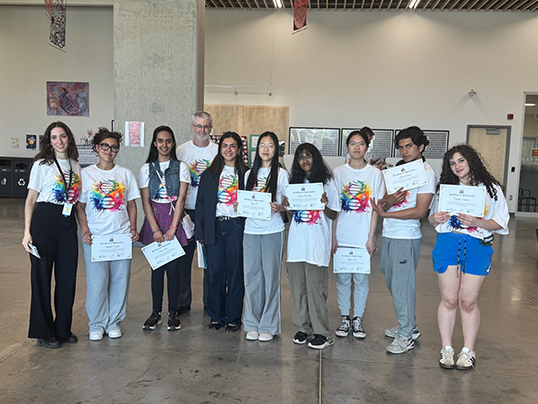
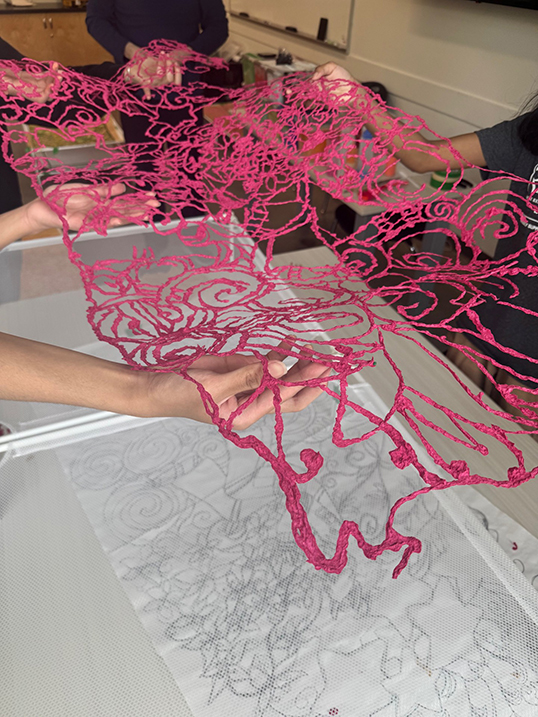
Art process of Woven Futures at New Westminster Secondary School.
Ailed Duarte, youth program manager at Multi-Lingual Orientation Service Association for Immigrant Communities (MOSAIC) says the Woven Futures program unites youth beyond language, cultural and age barriers.
Open to youth ages 12 to 18, program participants must live in Metro Vancouver and identify as a newcomer, refugee or “NEET” (Not in Education, Employment or Training).
“The Woven Futures program is an ever-evolving program: it adjusts very well to the communities in which it is located,” adds Teresa Larrea Correa, Woven Futures coordinator. “It has different phases in which we give prompts to students to help them envision what they could be doing now that they are in a new context.”
A new chapter
The program’s cohorts have so far been held in the Welcome and Wellness Centre at New Westminster Secondary School – the site of MOSAIC’s Settlement Workers in Schools program.
The grant, which supports two additional cohorts, will expand the program beyond New Westminster. Duarte and Larrea Correa are looking to bring Woven Futures to Vancouver and Burnaby.
“[The program] gives them space to reflect on where they are, what they want to do, and how to get there,” Larrea Correa says, adding participants are provided with materials to do this work. “While they’re doing this, they are also sharing the space with other people and sharing those ideas.”
Participants also work together to create a collaborative artwork that will be publicly displayed. Last year, students transformed shredded registration papers from the New Westminster Welcome Centre into handmade pulp and shaped it into a textured tapestry.
This year’s group is designing a wood-based installation with the help of a local teacher who paints murals. The students regularly receive support from community members – including teachers and counsellors – who act as mentors.
“Each student is going to add their own part, and we’re going to put it together like a puzzle piece,” Larrea Correa says.
Sessions begin with the sharing of food – a bonding experience that Larrea Correa sees as essential to creating comfort and a safe space. Students then participate in different exploratory activities.
“How do I see myself here and now? Not physically, necessarily, but what are my qualities? What are my connections? Who are the people that surround me?” Larrea Correa says of a self-portrait activity. “There’s a few sessions exploring the future – what are the future goals I have?”
Mapping inclusivity
Students then map their goals, identifying the necessary steps to achieving them. This mapping can take various forms, including writing and drawing. Larrea Correa sees this program as “very much self-orientated” with each student working on their own goals. She adds that adult mentors support participants by co-creating with them; the adults build their own maps.
“[This] is important because they are showing students that we all have futures and we are all still working on them,” Larrea Correa adds. “If you want people to take something seriously, you have to value it yourself too.”
The program also provides an inclusive space, encouraging participants to use whatever language they wish.
“After they made all these artworks exploring different areas of themselves and their futures, we come up with not only ideas of how each one of them is weaving their own futures, but how we weave our futures with our communities’ futures – with each other’s futures,” Larrea Correa says.
Duarte adds that with the grant, they will focus on a “train-the-trainer” initiative – supporting community members who wish to serve as mentors. The grant also allows them to expand their eligibility criteria to citizens, not just refugees and newcomers.
Larrea Correa emphasizes the program’s inclusivity – they welcome everybody, including persons with disabilities.
“We had some students that really took this project to heart and felt that they were given this opportunity to express and to be leaders too,” she says. “When you tell them you believe in them, they also believe in themselves and try really hard.”
Woven Futures is developed in partnership between MOSAIC, Simon Fraser University, REACH Initiative and local school districts.
For more information on Woven Futures, see www.mosaicbc.org/our-programs/woven-futures


Comments will load once you reach the end of the article.