
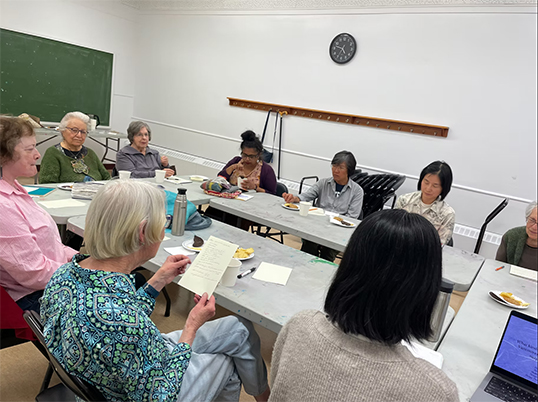
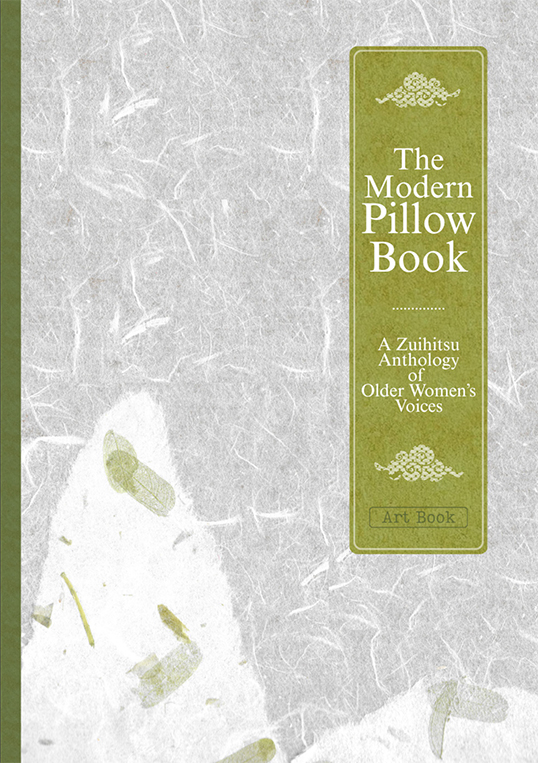
Inspired by a Japanese text written more than a thousand years ago, the event creates space for reflection, writing and shared practice. The work draws on zuihitsu, a Japanese literary style often translated as “following the brush,” mixing personal reflections with list-making.
“Ultimately, if we don’t know how to notice or how to observe, we won’t be able to tackle what’s in front of us,” Honda says. “We will not just treat The Pillow Book as something to study, but to be practiced, to live, to write about.”
The original Pillow Book was completed around the year 1002 by Sei Shōnagon, who was serving in the Japanese Imperial Court. Honda’s project approaches the text as a site of active engagement, highlighting the wisdom of women over 50 while bridging generational gaps.
Modernizing the ancient
Development for the federally funded project started in May 2025. A team of women contributed to an anthology. Their writings were guided by shared questioning: “What if Shōnagon’s alive today? What will she be observing [in] today’s world?”
A documentary, Shōnagon Now: Voices from a Modern Court, was also created. The project is now in its second phase: community engagement.
“For my organization, VACS, we use art as a means of social change,” Honda says. “Through community building or even [thinking about] environmental sustainability – whatever the issue that we are geared towards – we always use art as part of communication.”
The executive director intended to bridge the humanities, in the form of classical literature, with science. With a doctorate in public health, Honda interpreted Shōnagon’s text as a form of “social prescribing” – an approach to health care that encourages non-clinical and community-focused forms of care.
Just as social prescribing recognizes that health is shaped by small, everyday experiences outside the clinic, The Pillow Book finds meaning in fragments, lists and moments that might otherwise seem trivial.
“Sei Shōnagon understood that a list of ‘things that makes the heart beat’ or ‘awkward things wasn’t trivial,” Honda adds. “It was a record of being alive and aware. It’s about being present – it’s about noticing what’s actually happening in your experience.”
The Feb. 6 event will open with Honda presenting the connections between The Pillow Book and public health. Participants can then practice self-expression, responding to the same prompts used by Shōnagon.
Scholars Sharalyn Orbaugh (UBC) and Sonja Arntzen (University of Toronto) will provide academic insights.
“They’re really one of the few academics who know The Pillow Book really well, especially how this Pillow Book transpires to the rest of the [world’s] poets and scholars,” Honda shares.
Building community through art
A segment of the documentary will then be screened, inviting audiences to identify okashi in the film – translated as “an aesthetic quality that sparks intellectual curiosity and interest.” Two women from the project will then interact with the audience, allowing younger attendees to connect.
“Often, we don’t hear older women’s voices in media, even though they have so much wisdom and experience,” Honda says. “This is a great time for students to ask questions and find commonalities.”
All participants will then be encouraged to respond to a new prompt, moving towards a shared artistic creation. Honda first encountered The Pillow Book in “bits and pieces” during her school years in Japan.
“Now, years later, I’m reading it from start to finish, it’s quite striking,” Honda notes. “I finally can see how Japanese people back then looked at nature, including human nature.”
For her, the text is more than “a museum piece.” It offers a framework that speaks directly to contemporary concerns.
“It can be a training manual for solving modern crises, like loneliness or healthcare burnout,” she says.
These conversations place particular emphasis on older women’s perspectives, creating space for experiences that are often less visible in public cultural spaces.
“Lots of seniors, most of them are living alone, [their] children moved away or [they] are widows,” Honda says, noting some students experience the same loneliness. “Even for a short period of time, that connection matters.”
She adds that learning how to observe and pay attention is central to building those connections. The project treats attention and observation not as passive acts but as skills that can be practiced and shared.
“If we express the matters of the heart, there’s a guarantee that they will be received by someone, so we will continue that tradition,” she says.
For more information on The Modern Pillow Book project, see www.myvacs.org/about-6-1
To watch Shōnagon Now: Voices from a Modern Court, see www.youtube.com/watch?v=pcMvtvNPYME


Comments will load once you reach the end of the article.