

Onibana Taiko’s Noriko Kim Kobayashi in foreground with guest Teiya Kasahara on the Street Stage. | Kayla Isomura, 2022.
Powell Street Festival’s magic lies in creating space for difference, says former executive director Emiko Morita. The festival, which showcases Japanese Canadian culture, celebrates five decades this year with the release of Return to Paueru Gai: Fifty Years of Vancouver’s Powell Street Festival (Arsenal Pulp Press, 2026) and an exhibition at the Nikkei National Museum & Cultural Centre until Sept. 5.
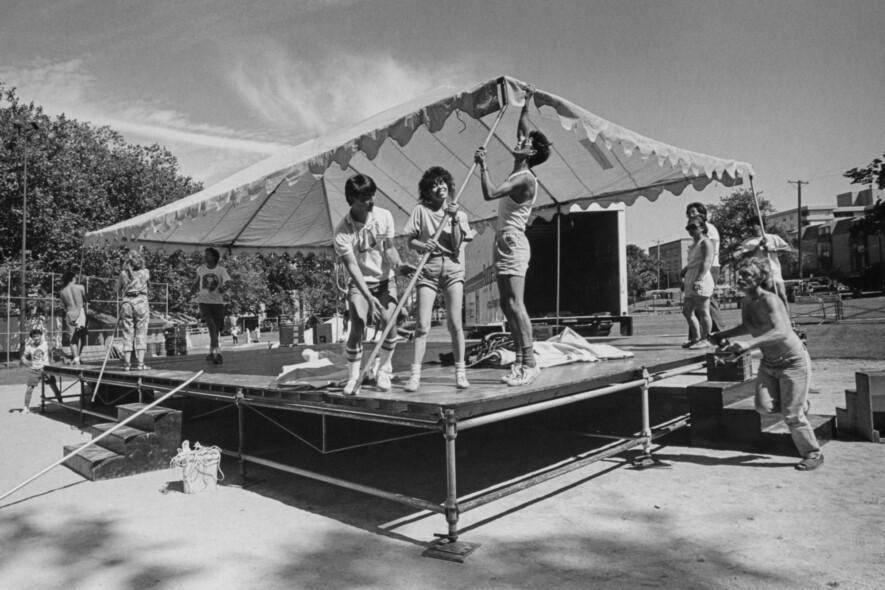
“You have people coming from so many different backgrounds, and at the end of the day, you’re getting dirty, sweaty and hauling rope or wood around,” Morita says of the volunteers’ experience. “It doesn’t matter what your background is or who you are, you’re all working towards one goal—and it’s fun.”
According to Morita, the festival’s roots reflected “desire and effort” to honour the early settlers and the issei—first-generation Japanese immigrants. The issei were forcibly removed from their homes and businesses during the Second World War as a result of Canada’s Japanese internment policy.
“In 1977, it was the first large public gathering since that forced removal,” the former executive director says. Unease and an undercurrent of fear were dominating emotions at the time—driven by state pressure to assimilate and avoid congregating as Japanese Canadians. “It felt risky because of real human rights violations through state policy.”
Festival legends
As editor and curator, she sees both the book and exhibition as documenting “legends” of the Powell Street Festival—stories full of love and meaning for the community. These legends involved famous objects, such as the tug-of-war rope, or notable events, like the flooding of Oppenheimer Park following damages to the sprinkler system.
Morita edited the book to be a resource or reference guide with essays, data, and timelines. It also includes an appendix listing every person or organization involved in each year of the festival.
“During my tenure at Powell Street Festival, I developed this question of how to transfer knowledge and how to articulate the ethos of the organization,” says Morita who oversaw 10 editions of the festival (2015 – 2024).
A particularly meaningful aspect of the exhibit is the display of volunteers’ hachimaki (headbands). Some volunteers donated their personal collections.
“It hangs above you as a metaphor for all the labour and passion that volunteers have contributed to the festival,” Morita says. “It’s not a commercialized, corporate festival— it’s very grassroots.”
The exhibit includes a sketch called “The Body Electric,” created from Japanese Canadian filmmaker Jesse Nishihata’s found footage. The video also features artist Roy Kiyooka and poet Gerry Shikatani.
Generosity of community
The exhibition also presents what Morita calls a playful “irreverence” of showcasing Japanese Canadian culture—one that she sees as accompanying the festival’s programming. Giant sushi costumes are an example.
“There’s this expectation that you’re going to perform this ‘Japanese-ness’ or ‘Japanese-Canadian-ness,’” she says. “People love it, and it has an ‘irreverence’ that really reflects the courage and openness of the Powell Street Festival.”
She sees the festival as paralleling her own “massive, personal growth.”
“More personally, I had this unexpected reframing of my cultural identity as a third- generation Japanese Canadian,” she says. “That’s a very complex, nuanced experience.”
In the early 20th century, Morita’s grandparents settled in the neighbourhood that became known as Paueru Gai (Japanese translation of Powell Street). The senior Moritas ran restaurants there. Like other Japanese Canadians, they were forcibly removed from their homes and businesses during the Second World War.
Morita adds that “feeling other,” particularly when defining one’s identity, is a common experience for many third-generation Japanese Canadians. Running the festival, she says, requires one’s “whole body, mind and heart” and working alongside those with a shared history.
“You’re learning a tremendous amount of how to be in community, in a good way, because you’re working in a very unique community of the Downtown Eastside where there’s a vulnerable population,” she points out. “A lot of my growing and learning came from the generosity of the people living in the Downtown Eastside.”
The idea of the festival and its organizers being guests on the site is a longstanding one, adds Morita who learned that the neighbourhood’s youth felt displaced by the festival in its early days. Its organizers then invited them to help with the festival’s production.
“That full inclusion made everybody feel comfortable and welcomed,” she explains. “When you come in today, one of the first things you’re taught [in terms of] the positioning of the festival is: you are a guest here.”
The most rewarding part of Morita’s experience was witnessing the festival’s “deeply integrated relationship” with the residents of the neighbourhood. She credits much of her personal growth to the generosity of this community.
“They have this wealth of strength, knowledge and practice of care that really enriched me,” Morita reflects. “I felt like I belonged in a way that I’ve never felt in my life, then my Japanese Canadian identity became more deeply intertwined with that sense of place and connection.”
For more information on Return to Paueru Gai: Fifty Years of Vancouver’s Powell Street Festival (the book), see https://powellstreetfestival.com/product/return-to-paueru-gai/.
For more information on Return to Paueru Gai: 50 Years of Powell Street Festival (the exhibit), see https://centre.nikkeiplace.org/exhibits/return-to-paueru-gai/.


Comments will load once you reach the end of the article.