
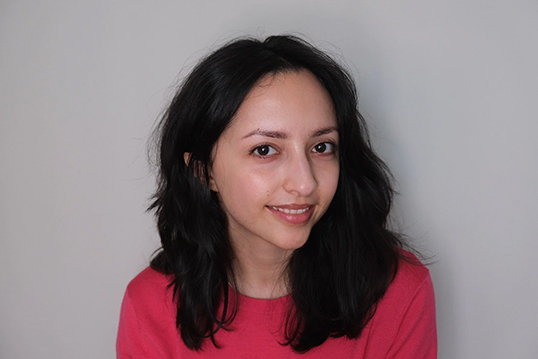
Tahmina Inoyatova, doctoral student.
“The Dubai developers actually recruited the Vancouver planners who designed False Creek to help create the iconic Dubai Marina, [and] now, developers in Dushanbe who are working on riverside projects are drawing inspiration from that same Dubai model,” she explains. “In a way, Vancouverism is travelling all the way to cities like Dushanbe.”
Inoyatova will explore this urban transformation in the upcoming talk, “From Soviet City to the ‘Dubai of Central Asia’: Power, Memory, and Modernity in Dushanbe” (Feb. 11, SFU’s Harbour Centre).
Presented by SFU’s Centre for Comparative Muslim Studies, the talk also features professor of geography Eugene McCann, who will help draw parallels between Dushanbe’s and Vancouver’s urbanism. All are welcomed.
Discourses of modernity
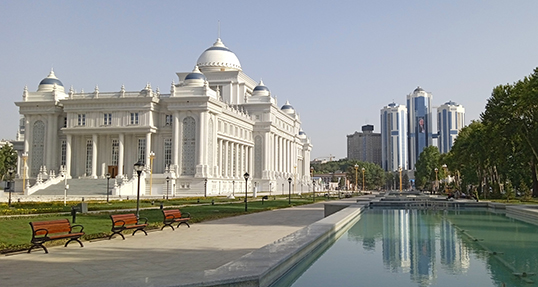
Dushanbe residents have described the city as becoming like Dubai, says Inoyatova. The comparison is a visual one – as Soviet architecture is transformed into glass high-rises.
“This new aesthetic of grandeur and scale reflected in the urban environment is making people associate Dushanbe with Dubai as a new model for urban development,” the researcher adds.
These changes – driven by state and private investors – are not limited to the Tajikistan capital. Inoyatova shares that it’s been witnessed in cities across central Asia.
“I think there is also a deeper aspect…specifically, an alternative vision of urban modernization,” she says. “This vision combines both Western and non-Western models of urban planning, and often, Dubai is an easy lens through which people see that.”
Researchers have referred to that process as “Dubaization” – the modeling of urban design on the Gulf City’s ‘futuristic’ architecture. A communications researcher, Inoyatova has been studying discourses around Dushanbe’s transformation, conducting interviews with residents and planners.
“How do residents negotiate this process? Do they resist it? Do they oppose it?” she asks. “Do they welcome this change? How do they do it? What kind of language do they use?”
Her research also examines top-down discourses – including those from the state. According to Inoyatova, these conversations usually promote the scale of Tajikistan as a nation.
“It’s a big state-led project to modernize the capital city, [and] the government takes pride in what’s happening and is trying to promote Tajikistan as a modern nation,” she says.
A hybrid city
The researcher adds that some Dushanbe residents have expressed nostalgia for the Soviet era. These residents see the destruction of Soviet architecture as erasing the country’s history.
“A lot of people are saying, ‘This is part of our history, this has historical value,’” the researcher explains, drawing a parallel with Vancouver’s NIMBY conversations. “At the same time, some people who express nostalgia refuse to participate in anti-colonial discussions.”
She adds that this group is mostly composed of middle-upper class urban residents. They might, for example, make Facebook posts describing the history of a Soviet building and its former inhabitants.
“At the same time, this is not the only narrative that exists,” the researcher says. “It’s a large city with over one million people – a lot of people welcome the change and subscribe to this new vision of modernity”
As Dushanbe residents continue to grapple with this transformation, Inoyatova believes the city’s future will be “hybrid.”
“I don’t think Dushanbe’s identity can be categorized as Soviet, post-Soviet, Western or non-Western,” Inoyatova reflects. “I think different visions of modernity will continue to contest and challenge each other, like in all cities.”
For more information, see https://events.sfu.ca/event/47408-power-memory-and-modernity-in-dushanbe


Comments will load once you reach the end of the article.