
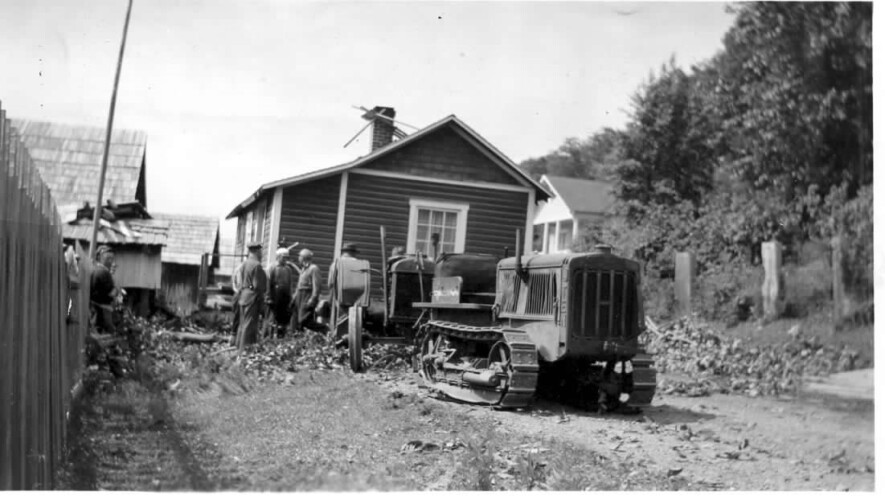
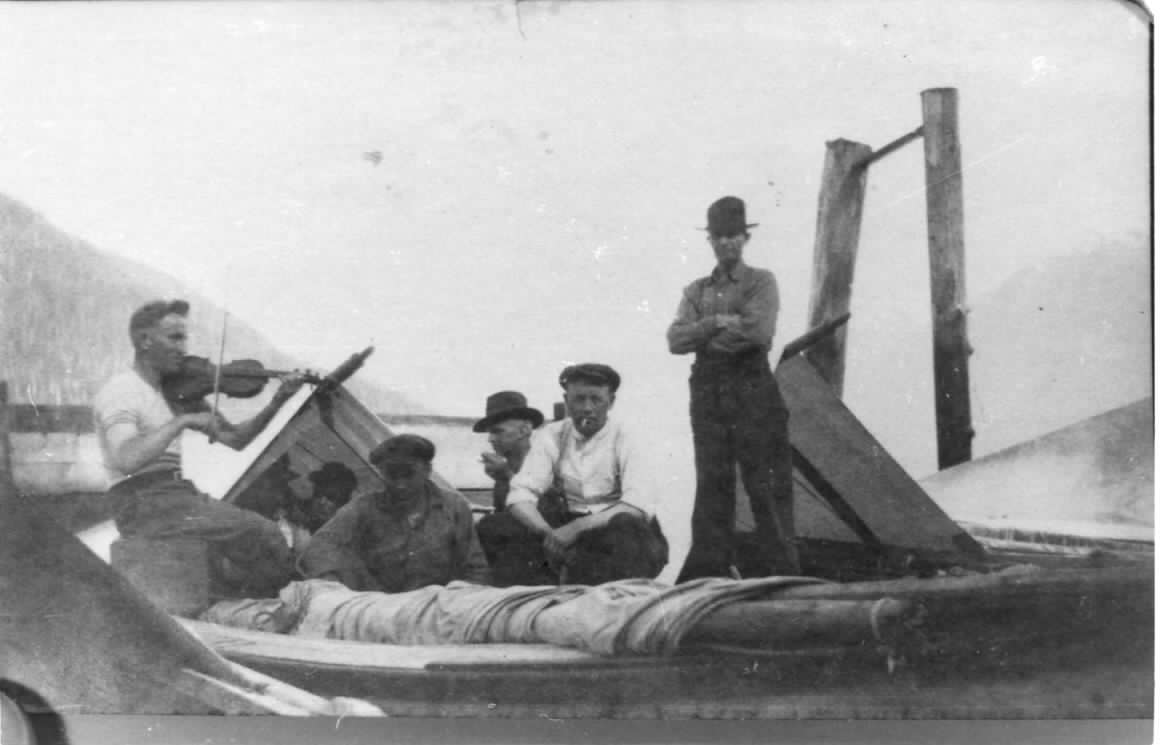
Early Sointula fishermen at Rivers Inlet | Courtesy of the Sointula Museum.
Historic Sointula is a testament to the power of small communities, says Kathy Gibler, archives manager of Sointula Museum. In the early 1900s, this Malcolm Island village located between northern Vancouver Island and the B.C. mainland northeast of Port McNeill was a Finnish socialist utopia, operated by Kalevan Kansa Colonization Company.
Sointula — “Place of Harmony” in Finnish — never had a formalized government.
“If you don’t have a government, you better work together,” says Gibler.
As BC Heritage Week returns Feb. 16-22 with the theme “Stir the pot,” the Sointula community can enjoy various food-related events: the Sointula Senior Association’s Finnish treats during their weekly Seniors Coffee Meeting (Feb. 17), Coho Joe Cafe’s Finnish pea soup, Hernekeitto (Feb. 18-22) and the Malcolm Island Food Company’s Pulla Pudding (Feb. 20-22).
“Getting together for coffee has always been big in Finland, and it was certainly big here,” Gibler says. “Everybody prided themselves on their baked cookies.”
The Vancouver Island Regional Library’s Sointula Branch will also display a special collection of Finnish cookbooks.
Gibler believes the settlement’s principle that happiness is rooted in community is still very much present.
“We’re a really strong community who are very proud of our history, and we are still run by volunteer boards,” she says.
This year also marks Sointula’s 125th anniversary— to be commemorated through a different monthly theme such as a public digitization project in April.
Creating a socialist utopia
The settlement began in 1901 when five Finnish miners from Nanaimo sailed by boat to Malcolm Island; only four made it. After two months, the settlement grew to 13, including a woman.
“Much of Scandinavia during [that time] were already interested in socialist ideologies,” Gibler adds. “It was nobody’s ideal job to work in a coal mine—they certainly had not been miners in Finland…they really, really wanted to go somewhere that was fairer to workers.”
Their Finnish newspaper, called the Aika, helped recruit more members from around the world. Gibler says the newspaper served as “a vehicle” for socialist discussions, attracting over 1500 subscribers at one point.
This year, the museum will digitalize English translations of the Aika on ARCA BC—an open-source repository of the province’s heritage. The settlement also had an orchestra, band, choir and theatre company.
Finnish journalist Matti Kurikka was invited to develop the settlement—a move that ironically led to the utopia’s demise. Gibler describes Kurikka as “a great idealist,” trying to figure out how to establish a new society.
“They didn’t believe in revolution, but it’s quite brave to try and do something that people haven’t done before,” Gibler reflects. “Kurikka’s ideas would be very comfortable today.”
His belief in gender equality—including women’s right to decide whether they should have children—divided Sointula. Half supported Kurikka; the other opposed his ideas, fearing that the government would repossess their lands if word about such talk spread. Kurikka left in 1904, along with approximately half of the settlement’s population.
“That’s when the hard times started: Now they had this huge debt and only half the people to pay it off,” Gibler explains, noting the debt largely came from the settlement’s funding of two local construction projects—including the Capilano Suspension Bridge. “The community ended up being bankrupted in 1905.”
A living history
Even among socialist utopias Gibler says Sointula was unique. Its early settlers were meticulous recordkeepers, leaving behind an archive of letters, member records and meeting minutes.
Another key difference was the settlers’ business-minded focus. Gibler says that Sointula had a company from the very beginning. Members had to buy a $200 share.
“Nobody had that money, so they said $50 dollar cash, and you can work off the other $150,” she adds. “They really didn’t want to pay a bunch of capitalists, so they started a cooperative store.”
That store—the Sointula Co-op—is now western Canada’s longest, continuously running cooperative. In celebration of BC Heritage Week, Gibler is making Finnish flags to place around the store’s products from Finland.
She points out that Sointula was also seminal in driving B.C.’s unionism, particularly in the fishing and logging industries. From 2022-2023, Gibler’s team conducted a historical photo identification project, which led to the creation of the documentary, “Sointula’s History and Memories.”
“It was people who had grown up together, and they thought [Sointula] was the centre of the world,” Gibler recalls. “They all said, ‘You are a generation too late’—they were children when these things happened, and I was surprised by how much they remembered.”
Now available on YouTube, the documentary features community seniors. It was shortlisted for the 2024 Governor General’s History Award for Excellence in Community Programming.
“Not only does the museum hold the community records, but the community’s people,” Gibler adds. “We have families coming—three generations—and they know right where their photos are…it’s grandparents teaching the next generation: they all come back.”
This year, Gibler’s team will partner with a labour museum in Finland, putting together an exhibition on Finnish utopias. A Finnish journalist is also working to create a virtual Sointula—capturing this place that, according to Gibler, is very much recognized by Finns as part of their history.
For more information, see https://sointulamuseum.ca/.


Comments will load once you reach the end of the article.