
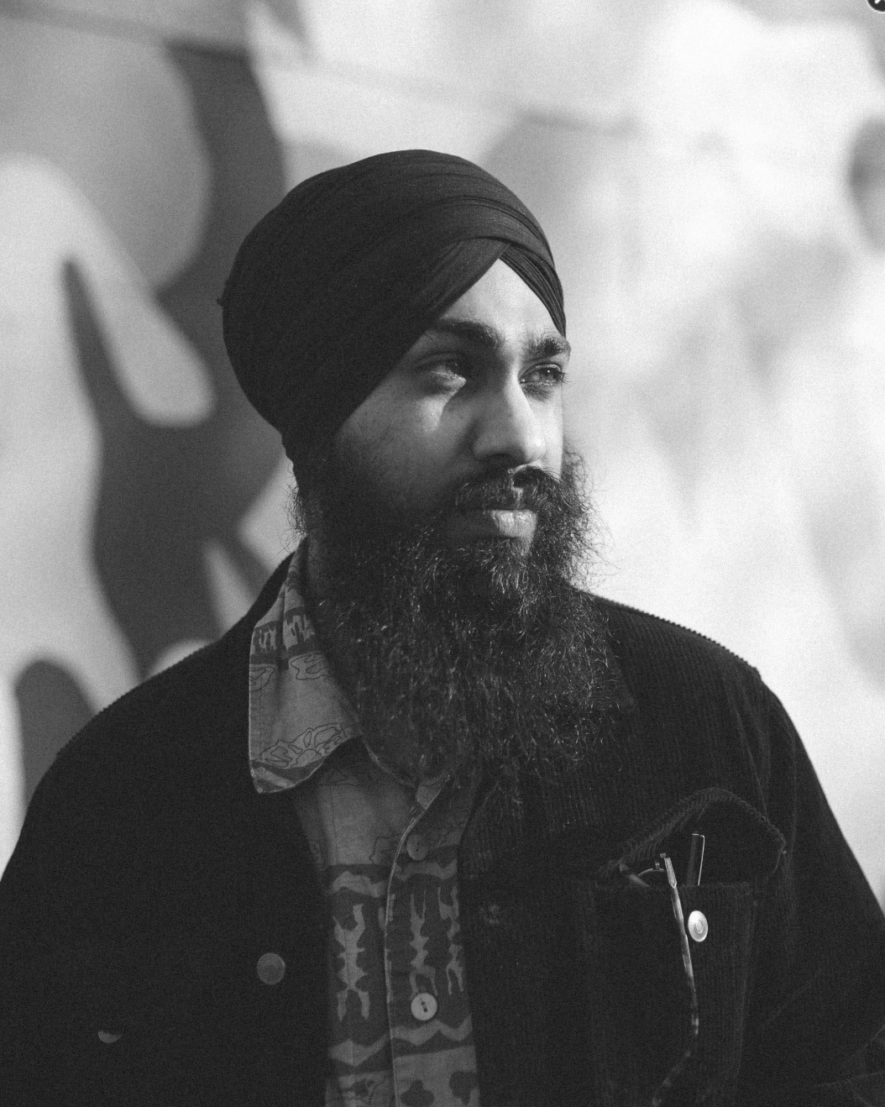

Imroze Singh Goindval | Photo by Imroze Singh Goindval.
Disability needs to be understood from different perspectives—including the “subaltern” or those who have historically been excluded, says University of British Columbia public scholar Imroze Singh Goindval whose work focuses on the Punjabi community. For Goindval, this work goes beyond examining the local diaspora: it also involves understanding global movements of colonialism and migration.
“A lot of times, the migrant population gets blamed: ‘If they have a problem, why aren’t they coming to the hospital or the ‘right places?’” he reflects. “The reason that they’re not coming or showing up is because the care was never really designed for them to assess.”
Challenging the role of stigmas
Goindval previously worked as a medical community interpreter for Provincial Health Services Authority’s Department of Provincial Language Services. He was sent to different places—including clients’ homes and hospitals—to support translation for the Punjabi, Hindi and Urdu speaking families.
“At one point, I got sent to an [autism] assessment of a young child in New Westminster, and that’s where I noticed a lot of the things that are not really discussed in the communities,” Goindval recalls. “There are certain ways of thinking about what does mental health look like.”
His observations include families responding differently to autism diagnoses depending on the child’s gender; availability of government funding impacting acceptance of the diagnoses; and stigmas associated with cultural beliefs.
“The continuation of the lineage, for example, is very important: Who’s going to be responsible when the parents are old?” Goindval adds that families may also see autism as a reflection of their karma. “It’s going to be the boy of the house, and when the boy is not delivering those promises, it results in a lot of shame from the community.”
He points out that stigmas should be understood from an intersectional perspective. Western healthcare, he says, tends to put the blame on stigmas without recognizing how these other factors—such as one’s immigration status, caste, religion and socio-political background—affect acceptance of diagnosis.
“I noticed that there isn’t much literature that can help us build an intervention yet because academia itself does not really understand how disability is understood in some of the migrant populations,” Goindval adds.
A symptoms-first approach
A barrier is the lack of direct translation for the word “autism” in Punjabi. According to Goindval, the closest translation for “intellectual development disability” is mandbuddhi. He adds that the term can be explanatory and derogatory: its interpretation depends on context, such as the user and their socio-economic power.
“That’s not to say the culture is ‘backwards,’” Goindval emphasizes that in the Sanskrit-Ayurvedic tradition, the term ‘buddhi’ takes the cognitive, emotional and spiritual faculties as one—a perspective that is “fundamentally different” from Western medicine’s framework. “If you go back into disability studies, you’ll notice that the term [autism] itself is fairly new.”
In fact, Goindval suggests that translating the word ‘autism’ isn’t all that helpful. His interviews with practitioners document how parents often “shut down right away” when approached with an autism diagnosis—a trend his work hopes to reverse by developing interactive, scenario-based resources.
“For example, we wouldn’t directly use the term ‘autism’ itself in the scenario; we’ll talk about the symptoms and what could it be, and then we will say, ‘It could be this or this or this, but before you come to a conclusion, go talk to a doctor,’” Goindval has so far built four of these resources. “Another scenario is actually helping them understand the process of what it looks like to get a child diagnosed in the B.C. system.”
These resources will eventually be available in Hindi, Urdu and English. Goindval also plans to develop explainer videos shareable through WhatsApp messages—a common way for cultural communities to spread information.
For more information, see https://www.grad.ubc.ca/campus-community/meet-our-students/goindval-imroze-singh.


Comments will load once you reach the end of the article.