
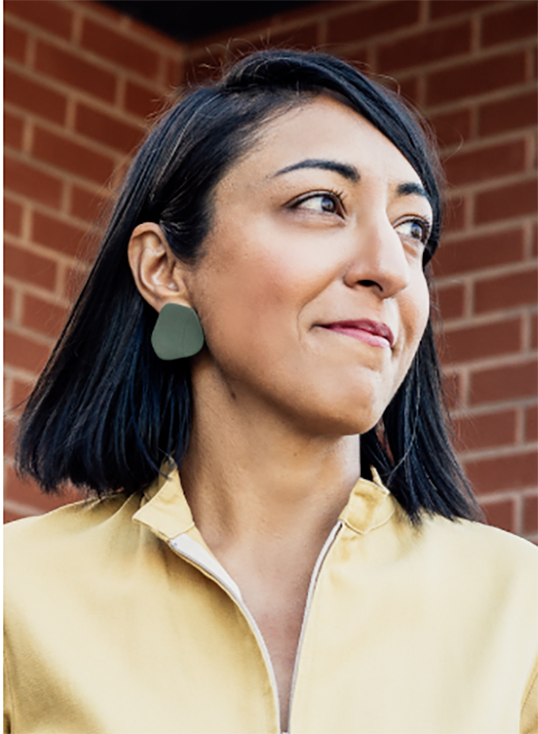
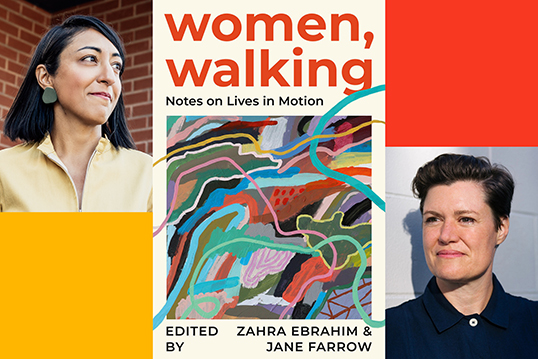
Cover of Women, Walking: Notes on Lives in Motion. | Photo courtesy of VPL.
“We thought we would have a conversation about what walking means. There’s the ordinary to the poetic, the ordinary to the extraordinary,” says Ebrahim describing the event.
The Women, Walking anthology brings together 30 contributors whose stories explore walking through the lenses of identity, self-care, grief, social connection and cultural consciousness.
From a seven-minute walk to a life-changing experience
Ebrahim’s most meaningful walking memory is the seven-minute walk home from middle school in Vancouver, when listening to music helped her calm herself, recognize her needs and learn to care for herself.
“It helped me build the muscle to be able to take care of myself all through my adult years,” she states.
For Ebrahim, an urbanist with 20 years of experience working with cities and communities, the book grew from a simple observation. Although women walk every day, books about walking have often missed their experiences.
Finding women’s stories on foot
Ebrahim, who co-edited the anthology with Jane Farrow, traces the book’s beginnings to a small bookstore in Bloomfield, Ontario, where she discovered an extensive collection of walking books. As she browsed the shelves, she noticed that most were written by men. Meanwhile, books by women often focused on extraordinary journeys rather than everyday walks.
Women were walking to work, walking their dogs and moving through their neighbourhoods, all while navigating their own thoughts, identities and experiences, says Ebrahim who wanted to capture those stories, including the ordinary moments that can hold unexpected meaning.
“Community members leave walks to tell stories about the place they live or the place they work or a place of significance to them,” she says.
Ebrahim and Farrow approached writers they admired, including established literary voices, while also reaching into their communities to invite people whose stories might not otherwise be heard. The book was published Sept. 1, 2026.
Their prompt was straightforward: write about walking.
“I was expecting big stories, about big walks, but really they were just discreet and humble and incredibly revelatory. This thread ties the entire book together,” says Ebraham.
The stories include an anonymous account of being a Palestinian woman walking. Another is by an Indigenous woman escaping domestic violence with her children. One woman writes about walking home from a doctor’s appointment and seeing the city with different eyes. In another story, the writer reflects on walking a familiar route over many years. She discovers wonder and respite in a tucked-away rose garden. Walking in protest, hating walking and walking supplies were all discussed.
“Even friends and family and colleagues say they have got a story. Their stories reveal profound things happening on an ordinary walk,” says Ebrahim.
Walking with another person offers a different kind of connection.
“Women walk together. There’s an intimacy to walking together.” Ebrahim adds.
Who feels free to walk?
The anthology also examines how gender, age, race, culture and other aspects of identity influence the experience of public space. Women may consider their safety, surroundings and how others perceive them when deciding where to walk.
As an urbanist, Ebrahim sees walking as a valuable way to understand communities. Walking alongside residents can reveal needs that surveys and public meetings might miss, from places to rest to the everyday experiences of newcomers finding their way around a city.
“We just hope everyone sees themselves in the book,” Ebrahim says.
Women, Walking invites readers to reconsider an everyday activity and discover how even a short journey can offer insight into ourselves, our neighbours and the places we call home.
Register at Zahra Ebrahim: https://vpl.bibliocommons.com/events/6aa465cb6074830038264fd4
For more information: Call (604) 331-3603 or email: [email protected]


Comments will load once you reach the end of the article.