
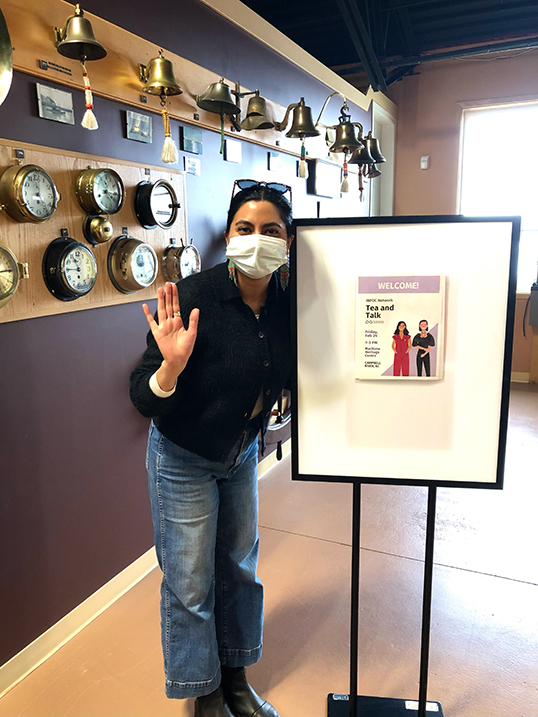
“It’s a way of bringing people together and creating a low-barrier way for them to meet each other,” says Jazmin Hundal, the equity initiatives manager at BCMA and one of the driving forces behind the network.
A supportive community
According to Hundal, people of colour may feel out of place in their workplaces due to the lack of representation, amongst other issues. The IBPOC Cultural Professionals Network addresses this concern by facilitating professional collaborations and even friendships.
“A lot of it comes from just my own experience of being a brown woman working in museums and not seeing anyone like me,” she adds, noting how microaggression and stereotyping continues to exist in the workplace.
The network is particularly crucial in addressing the isolation that many IBPOC professionals feel when working in predominantly white institutions. Hundal also notes that participants have experienced difficulties requesting time off to attend these professional development events – an issue the network has addressed through justification letters.
“[The letters] are drawn from the in-person conversations I’ve had with management, as well as those emails and all of that background support, and [it is] put into an accessible format,” she explains of the template document that members can present to their managers when justifying their participation at the network’s events.
She emphasizes another pressing issue that IBPOC professionals face in the archives: the expectation that they will shoulder additional labour without adequate compensation. Many racialized professionals are tasked with leading equity, diversity and inclusion (EDI) initiatives or engaging with their own communities on behalf of institutions – often without recognition or fair pay.
“It means leveraging your personal relationships, spending that time outside of your work day, doing this work,” Hundal explains, stressing the need for equitable pay structures, workload adjustments and recognition of the emotional labour involved.
Key initiatives
The IBPOC Cultural Professionals Network hosts several programs designed to address the specific needs of its members. One of its flagship initiatives is Tea & Talk, a monthly online meeting that provides a supportive space for discussion. Holding it in conjunction with her coworker Madison Bridal, Hundal admits that Tea & Talk can often venture into fairly heavy discussions.
“We’ll cover really traumatic topics, but sometimes they’re light and it’s just an easy way for people to get to know each other,” she says.
Since Tea & Talk can be emotionally charged, Hundal decided to hold the IBPOC Network Podcast, which she describes as a ‘place for joy’. For her, there is power in encouraging people to share their stories, including why they chose to work in the sector.
“I firmly believe that you’re the best at telling your story,” she adds. “[The podcast makes] it easy for them to tell their story, instead of me sharing it.”
Another significant initiative is the IBPOC Career Services, which offers mentorship opportunities and professional development resources. Additionally, the network collaborates with BCMA’s queer network to host a Book Club, creating an intersectional space where individuals can engage with diverse literature and media. Hundal adds that the network values how some individuals are more comfortable expressing themselves in a queer-friendly space.
“We don’t want people to feel like they have to pick and choose parts of their identity to find support with us,” she says.
Over the years, Hundal and her team have expanded their programming, including their Tea & Talk in order to host in-person events across B.C.. The network will also continue its podcast and career services while exploring new ways to support its members.
“Bringing people together this way in the network has really shown me that all of our challenges are the same,” Hundal shares. “No one has all the answers, but I believe in the power of our collective to figure it out.”
For more information visit: https://museum.bc.ca/networking-mentorship/bcma-networks/ibpoc-museum-professionals-network


Comments will load once you reach the end of the article.