
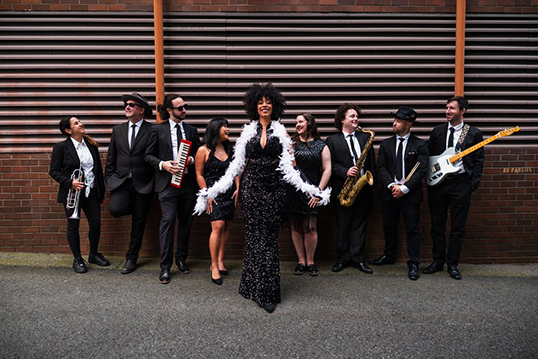

Krystle Dos Santos. | Photo courtesy of the Firehall Arts Centre.
“This time, [the show will touch on] what happened after Motown: how the legends that were created turned into full on icons…The one-namers like Diana, Michael, Lionel,” she says. “A lot of them changed record labels after they left Motown Records. They either grew out of it, they changed it, they wanted more creative control.”
Besides the artists, A History of Motown journeys into the politics of the music industry at a pivotal time, and invites reflection on Canada’s own relationship with storytelling, identity and Blackness.
The art, sound, and business of making history
In the late 1950s Berry Gordy Jr. – a high school dropout turned professional boxer, then soldier, then chaplain’s assistant, then songwriter, and finally, music executive – founded what would become the Motown Record Corporation.
In the following decades, Motown developed a roster of artists, creating a fresh sound from familiar genres including R&B, pop, and gospel.
Yet Motown’s success, according to Dos Santos, was more than a happy accident borne of artistic exploration. It aimed at a specific outcome: to break the glass ceiling for Black artists in America.
“There was such a clear manifestation happening. Berry Gordy Jr. wanted to create a universal sound of music that his Black artists could exist in all the radio stations and music communities,” she points out. “He very strategically chose the band, the style of music, [and] songwriting in a really specific way to create a universal sound.”
At the time, Dos Santos explains, while the catchy sounds were designed to be accessible to all, Motown Records was acutely aware of the key demographic to entice.
“Sometimes I feel controversial saying this, but the truth is that Berry Gordy Jr. really wanted to target white, teenage white demographics because they were the ones who were spending the money. They were the ones going into record stores and buying stuff.”
Art, identity, and the retelling of the stories that shape us
Dos Santos argues that lying beneath Motown’s upbeat tunes are deeper questions of identity and recognition. She underscores the ways that such stories inspire a reflection on race, storytelling and enduring systemic barriers in the construction of our individual and collective identities.
As a first-generation Canadian born to two Guyanese parents of mixed ethnic origins, Dos Santos credits this form of art-inspired introspection for her own understanding of the world and positioning in it.
Speaking specifically of Blackness in Canada, she contends: “I think that the way that we’ve handled racism in our country is so much more covert, and it has sort of done us a disservice…I think the overt racism that happens down on the other side of the border, allowed for Black people to [ultimately] be acknowledged. [In Canada], Viola Desmond’s story was virtually unknown to anybody other than in her own communities or on the East Coast for 60 plus years.”
Dos Santos has used her own art to share Black Canadian history, notably Hey Viola! the play which presents the story of Canadian civil rights activist Viola Desmond (1914–1965) through performance and song. In 1946, she was arrested for refusing to leave the whites-only area of the Roseland Theatre in New Glasgow, Nova Scotia, thereby challenging racial segregation.
Similarly, A History of Motown repackages key moments and figures in history to tell stories that matter through musical accounts of the resilience and hope that have shaped North America’s cultural fabric.
For more information about A History of Motown, please visit: www.firehallartscentre.ca/event/a-history-of-motown-3


Comments will load once you reach the end of the article.