
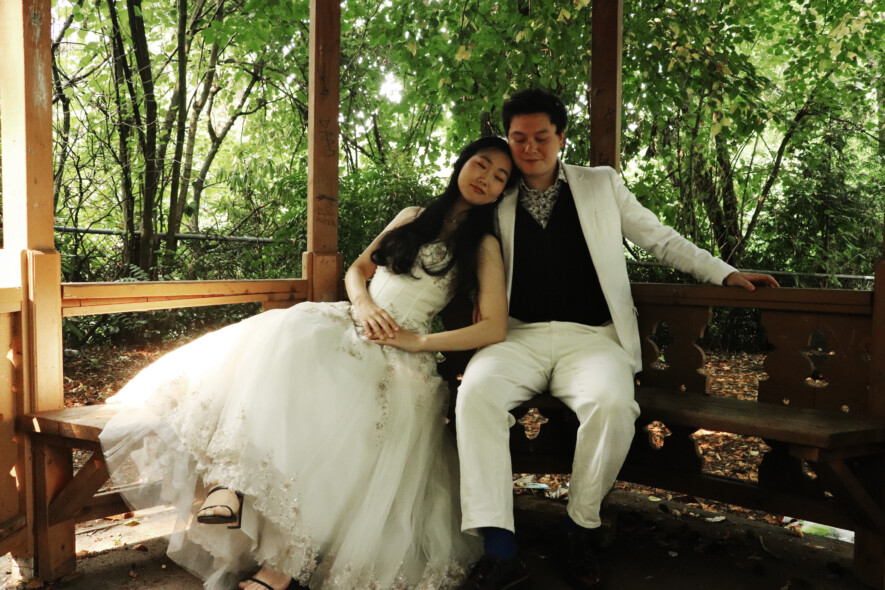
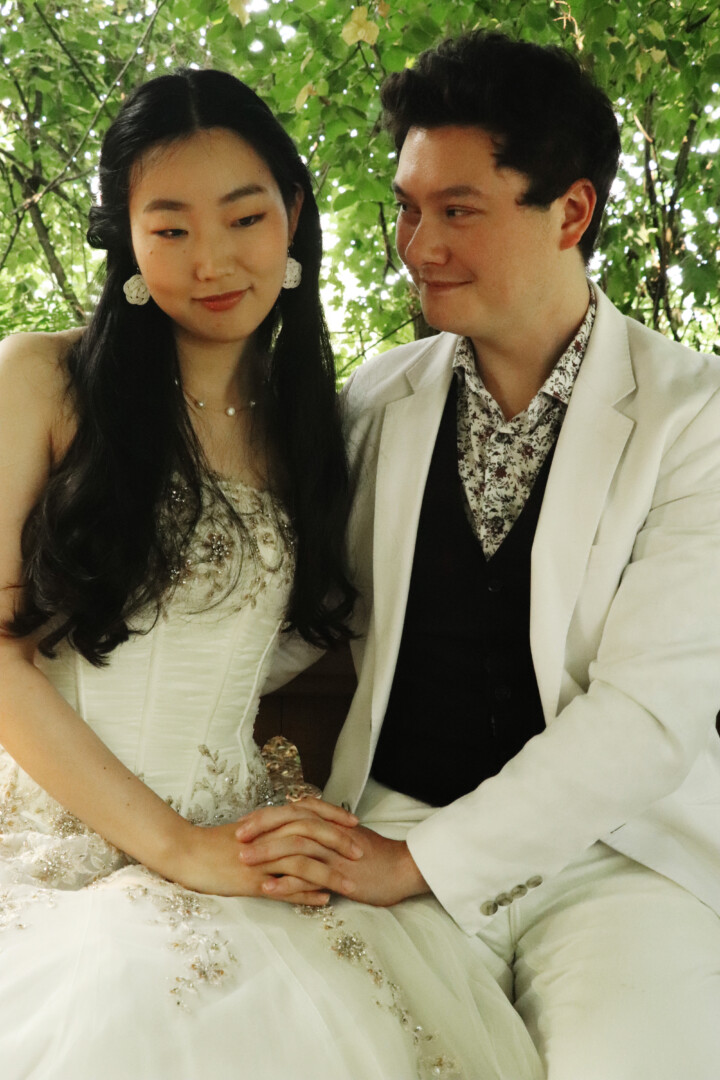
Ayako Karasawa and Kenneth Seto Tynan in Mizuhiki. | Photo by Joelle Wyminga.
Kenneth Seto Tynan and Ayako Karasawa’s Mizuhiki—exploring the (un)breakable bonds connecting loved ones—will take the stage at Granville Island’s The NEST (Sept. 11-13, 15, 18 and 20) for the Vancouver Fringe Festival. Its namesake draws inspiration from a Japanese ceremonial wedding knot, which Seto Tynan sees as the “beating heart of the show.”
“What if we took the worst parts of ourselves and put those into a play?” he says Mizuhiki explores how knots—or connections between people—can be re-tied after the initial cut. “A lot of times when we think about marriage or friendships, there’s a part of us that’s very much along the lines of ‘this is forever, we’re tied,’ but then, we have divorce and friendships that don’t work out.”
“I hope [this show] is going to bring a little bit more perspective on something that isn’t understandable or familiar—getting audiences to think about, ‘Oh, that’s interesting, I’ve never thought of that,’” Karasawa adds.
Cross-cultural (mis)communications
Mizuhiki is a Japanese knot-tying artform. The knot takes various forms and is used in different contexts. The play centers around the awaji knot—a representation of the couple’s unbreakable bond. Local artist Sachie Murakami of Shizuriya Art instructed the creator-performers on mizuhiki making.
For Karasawa, the mizuhiki—with two threads coming together into a knot—symbolizes the joining of two individuals into a team. The show also features Hokkorün handmade accessory by Mariko Karasawa.
While fictional, the play’s two characters—newlyweds Frank Bai and Iori Fujiwara—are inspired by the creator-performers’ respective lived experiences. The name “Frank” signifies a direct approach to communication; “Bai” resembles the pronunciation of “white” in Mandarin, signifying the character’s “wasian” (white and Asian) identity.
“One of the quotes in the show is, ‘If you don’t say it, it doesn’t exist,’” Seto Tynan shares of Frank’s characterization. “I feel like that’s a very Western approach to things. Everyone is up front about things; there’s not a lot of masking.”
Frank’s approach conflicts with that of his wife, Iori, whose Japanese culture calls for more indirect communication, or what Seto Tynan describes as “reading of subtext.” Her name means “weaving” in Japanese.
“She’s a person who couldn’t fit in Japanese culture,” Ayako adds that the show deals with cultural miscommunications. Western culture tends to directly address problems; Japanese culture prioritizes self-reflection of one’s wrongs. “When you marry, you bring what you are familiar with from your culture.”
“One of the things that is very funny about Frank is that he’s … just a loving person and just trying too hard,” Seto Tynan shares how the character’s openness—when contrasted with Iori’s reserved nature—is comedic.
Finding belonging
The two creator-performers—who tied their own knot last summer—see the show as creating space for all Asian experiences.
“We’re discovering in this play whether or not they are a good couple, and how can their knot be retied,” says Seto Tynan. “It’s also [about] understanding how you fit in.”
The play touches on what he calls “lateral violence”—the infighting that occurs between minority groups.
“We’re discussing strong points about the Japanese perspective in coming to Canada and talking about the ‘wasian’ experience and trying to understand your own cultural identity,” Seto Tynan points out how the “wasian” experience is often devalued. “We’re white-passing, so we get more, but we also get less in a lot of ways.”
“Humans want to belong somewhere,” Ayako recalls feeling like an “outcast” in Japan. “For Kenneth, he wasn’t Asian enough; for me, I wasn’t Japanese enough even though I was born in Japan.”
Seto Tynan hopes Mizuhiki expands worldviews, leading to fewer microaggressions. He adds that, their director Dar Uy—who is “Chinese but grew up in the Philippines”—also brings the perspective of a minority within a minority.
For more information, see https://www.vancouverfringe.com/events/mizuhiki/.


Comments will load once you reach the end of the article.