
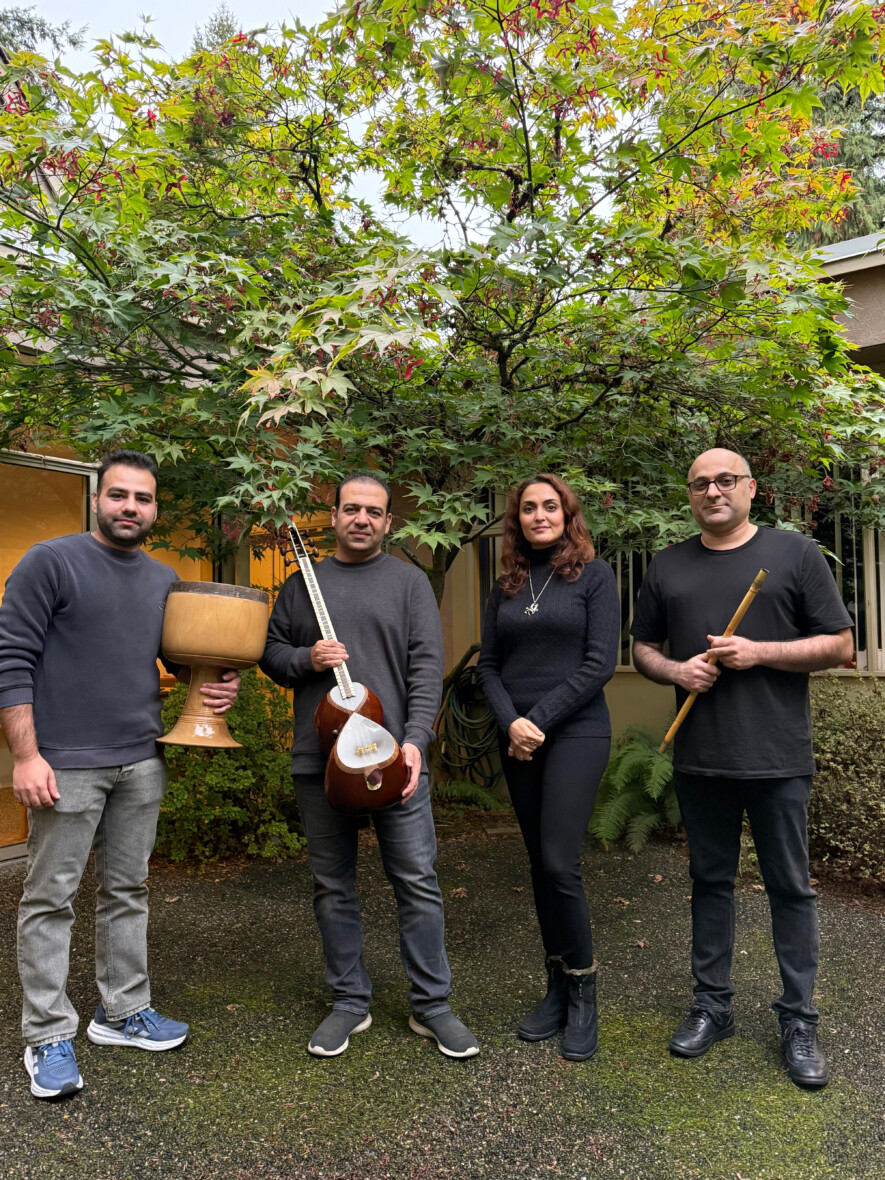
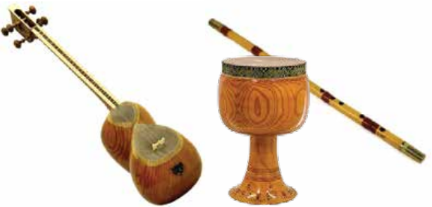
From left to right – the tar, the tombak and the ney. | Photos courtesy of The Aftab Ensemble.
“Iranian music is closely related to poetry and human emotions,” says Farzaneh, who is also a member of the Iranian Music Society of BC (IMSBC). “The main themes are often love, life, hope, separation, nature, spiritual feelings – that kind of stuff.”
In celebration of the diverse peoples, languages, and cultures of Iran, Farzaneh’s ensemble hopes to showcase both the masterful teachings and collaborations of the IMSBC.
Aftab, where sunlight can be felt through song
Music is a universal language, points out Farzenah: you can connect with people from different cultures.
And as a band of four musicians, Farzaneh believes that what makes the Aftab Ensemble special is how the Persian instruments – as well as the singing voice of Pegah Hajimohammadi – work together to create something akin to a conversation between the musicians. They especially embody the Persian word “aftab,” meaning “sun” or “sunshine.”
“In Iranian culture, the sun presents light, warmth, life, growth, and new beginnings,” says Farzaneh. “And I think music is a little bit like sunshine: it can bring warmth, happiness, and positive energy to people.”
In Western music, there are full-notes and half-notes, whereas in Persian music there are mainly quarter-notes, Farzaneh notes. Despite feeling off-key sometimes, this Persian musical repertoire tends to feel exquisite when listened.
“Different instruments, they have different characters,” says Farzaneh. “For example, the tar that I play is a very strong string instrument has a very sharp and expressive voice that can handle very strong emotions.”
Radif, an order of emotive and melodic expression
Iranian music has a very long history going back thousands of years, says Farzaneh. However, the contemporary version of Iranian music one will hear during “Music of Iran” is built on a system called Radif (Persian: ردیف, meaning “order” or “row”). Radif is a “collection of traditional melodic figures, in that musicians learned to use as a foundation for their performance.” These melodic figures, known as gushehs, are grouped into modal systems called dastgahs which is a “musical system with its own melodic and musical characters.”
Radif was first formulated from the ancient maqam system and refined during the Qajar dynasty (late 18th to early 20th centuries) when Iranian music came into increased contact with Western musical ideas such as the need to codify and preserve indigenous heritage.
“Today, musicians continue to perform this music around the world, keeping the tradition alive,” says Farzaneh.
But more than a musical system, Radif and its twelve systems of dastgah encapsulate Persian cultural memory, Persian poetry, and Persian aesthetics with its rhythms and melodies. Furthermore, listeners can comprehend the emotional philosophies of Iran thanks to the Iranian instruments that serve as vehicles of those emotions.
He highlights the ney, an Iranian reed flute to be played by Mohammad Mehraban, which “carries a lot of sad emotions or just love behind that.” He also emphasizes the tombak, a Persian hand drum to be played by Arman Tajmirriahi which provides rhythmic foundations and patterns the other musicians can rely upon.
“Based on that, once you understand it, you can create and get a lot of different emotions and feelings out of these amazing combinations of sounds,” says Farzaneh.
Although wanting to stick to traditions, the Aftab Ensemble plans on moving from Mokhalef Segah, one of the dastgah that is known for its mysterious and plaintive mood, to a different dastgah known as Bayat-e Esfahan, characterized with its noble and introspective attitude.
Farzaneh also adds that the Aftab Ensemble will be presenting traditional trasnifs, Persian songs with vocals and lyrics.
“We will also improvise, sometimes with rhythm, sometimes freely [and] no rhythm,” says Farzaneh. “Improvisation is an important part of our traditional music, and we hope the audiences feel emotions and beauty from our music even if it’s their first time.”
To learn more about “Music of Iran: Aftab Ensemble,” check out the link:
https://vpl.bibliocommons.com/v2/events/6ad1298bf4d1423e2ce35c3e


Comments will load once you reach the end of the article.