
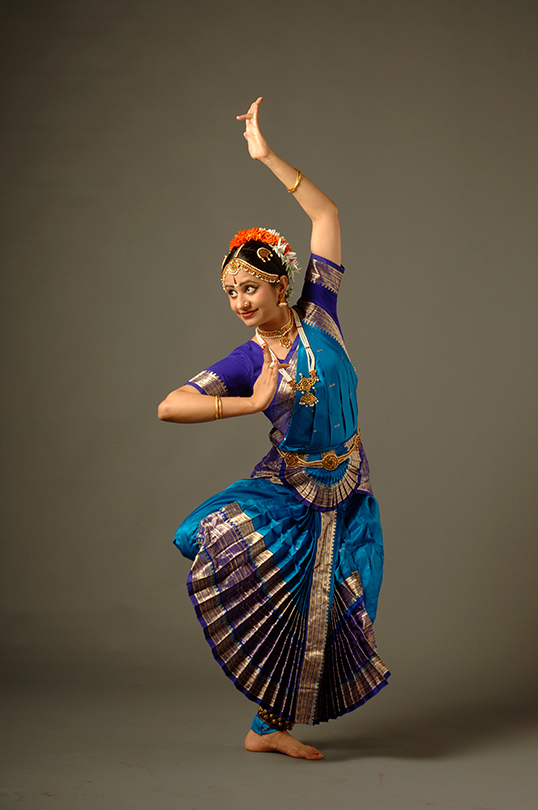
“We’re bringing our different practices into one program, while keeping the identity of each form distinct and visible,” says Vidya Kotamraju, solo performer of the Bharatanatyam dance-style and founder of the House Of Indian Dance.
Although there are eight unique classical dance forms from India, the program will mainly show five: Bharatanatyam, Mohiniyattam, Kathak, Manipuri and Odissi.
“Each of these art forms has its own artistic language embedded in its music, vocabulary, and its history,” says Kotamraju.
Like her other peers and colleagues, Vidya hopes to make Indian classical dance more accessible and visible to a wider audience.
From temples and royal courts to the public stage
Indian Classical Dance is one of the oldest dances in human history. Bharatanatyam, specifically, is considered the oldest of the eight Indian classical dances, originating from ancient Tamil Nadu, India.
“[Bharatanatyam] is known for its half-setting, its geometrical lines and footwork and expressive storytelling,” explains Kotamraju regarding her expertise. “Each of these classical Indian dance forms has a distinctive movement, vocabulary, history and also music.”
In ancient times, the Devadasis, known as “the servants of God,” were the ones who performed the eight major Indian classical dance forms in Hindu temples and the royal courts to honour deities like Nataraja, the god of dance and avatar of Shiva.
“A lot of artists, musicians, teachers of the art form carried these practices across the generations,” says Kotamraju. “And then there was a reform in the 20th century that reshaped the modern concept of these forms, which is how Bharatanatyam evolved. The main reform that happened were that the traditions came on to the modern stage versus being performed in the temples and the kings’ courts.”
Kotamraju and her colleagues hope to continue this reformation vis-à-vis “Intro to Indian Classical Dance: Dances of India.”
A language of motions, a story of dance
Much of Indian classical dance stems from the threefold components of Nritta (pure technique of dancing), Nritya (expression of dance conveying sentiments and narrations) and Natya (dramatics of dance). Furthermore, performers employ Abhinaya, a technique of expression that utilizes facial expression (Bhava), hand gesture (Mudras), eye movement (Dristi) and body posture (Angika) to convey a story without words.
For example, Mohiniyattam, which is to be presented by Bhavya Mathew, is “often associated with really rounded, swaying movements, like lyrical swaying movements.” Kathak, to be shown by Akshaya Surve, highlights “rhythmic footwork, spins, and storytelling.” Meanwhile, Manipuri, which Arno Kamolika will perform, “has some flowing movements, as well as very energetic traditions.” Finally, Odissi, to be performed by Sudhesna Mohapatra, is associated with the “three-bend postures.”
The “Intro to Indian Classical Dance: Dances of India” will delve more into the details of these unique art forms.
In spite of their differences, Kotamraju believes that these dance-forms “connect movement with rhythm, music, expression, and storytelling.” These ideas are embodied differently in each of these dance traditions, explains Kotamraju further. Although one may not quite know the language of a song being sung, viewers can nevertheless recognize joy, longing or wonder in a dance’s expression.
The rigours of expression
Being a contemporary Devadasi, or a regular performer of classical Indian dance, is no easy endeavour.
“We have a heritage that is very important, but also the practice involves strong technique, artistry, musical knowledge and years of rigorous training,” says Kotamraju. “There’s some practical challenges in presenting the work, for instance, when we do it with live musicians or finding suitable rehearsal spaces or even sustaining the time and resources needed to perform.”
There are also issues of accessibility, how performers like Kotamraju and her contemporaries can welcome people with these art forms. It was for this reason why she helped found the House of Indian Dance, as the organization helps to “break barriers on Indian dance one step at a time, and that’s creating more opportunities for people to experience [classical Indian dance] with practice and care, with curiosity and rigour.”
To know more about these unique dance-forms from India, click the link to know more about the upcoming “Intro to Indian Classical Dance: Dances of India”: https://vpl.bibliocommons.com/v2/events/6aee37419d27a0004556333e


Comments will load once you reach the end of the article.