
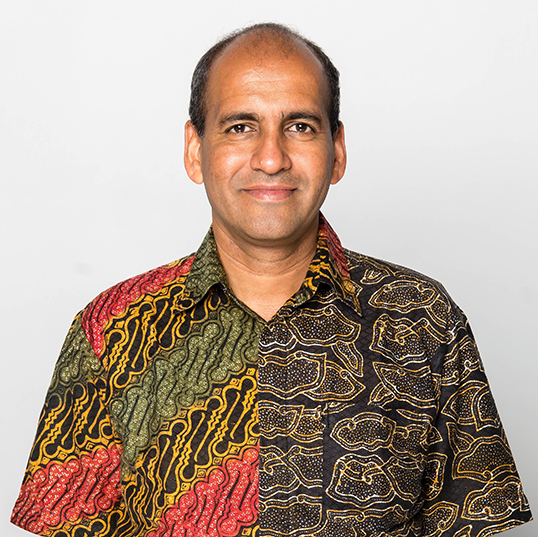
M.V. Ramana. | Photo by Paul Joseph.
His book, Nuclear is Not the Solution: The Folly of Atomic Power in the Age of Climate Change, challenges the idea that nuclear energy is a cost-effective and desirable solution for the climate crisis.
“Scientists should be emphasizing the idea that science and technology should not be used for military, destructive purposes,” Ramana says.
A costly risk
Ramana is a professor and the Simons Chair in Disarmament, Global and Human Security at the University of British Columbia’s School of Public Policy and Global Affairs. His book examines nuclear energy from two perspectives: the first focuses on its feasibility.
“Nuclear energy is a very expensive way to generate electricity,” he says. “You have to figure out a way to keep these radioactive substances from ever coming into contact with human beings.”
For Ramana, the time required to set up a nuclear power plant also makes it a poor solution for a time-sensitive crisis like climate change.
“You cannot start building a reactor right away,” he explains. “It would take roughly about 10 years, on average, for a nuclear power plant to go from where you start putting concrete in the ground to the point where the nuclear power plant starts generating electricity.”
He adds that this timeline is further extended by other challenges. For example, finding communities willing to live next to a nuclear power plant can further delay construction.
“If B.C. had decided to build a nuclear power plant, it would be the 2040s before we can actually start generating any nuclear electricity,” he explains.
Ramana also points out that fundraising the “tens of billions of dollars” required to build a nuclear power plant is another barrier to quick implementation. According to the professor, solar and wind energy are cheaper ways of generating low-carbon energy.
“If you are going to be investing tens of billions of dollars into nuclear power, you are not only delaying when the emission reductions might happen,” Ramana says. “You are also taking money away from a cheaper and quicker way of achieving emission deductions.”
He points out that every nuclear power plant risks causing “catastrophic accidents” – making them undesirable as solutions to climate change. The disposal of radioactive waste is another concern.
“There is no demonstrative way of safely dealing with this waste,” he explains. “The best one can hope for is to bury it underground somewhere and hope and pray that it never contaminates the water or the soil.”
Because nuclear waste can stay hazardous for “hundreds of thousands of years,” it is not possible to determine whether this waste disposal method is truly secure.
The “right” questions
“If there is going to be an expansion of nuclear power in the world, you are also increasing the risk that more and more countries will get nuclear weapons,” Ramana shares. “And more nuclear weapons mean a higher likelihood of nuclear war.”
The professor does not recognize “mutually assured destruction” as a practical deterrence to nuclear war.
“There should be diplomatic, international treaties that require countries with nuclear weapons to give up their nuclear weapons,” Ramana says, adding Canada could play a bigger role in these conversations. “There is overwhelming support for this kind of effort from around the world.”
In 2017, the UN adopted the Treaty on the Prohibition of Nuclear Weapons. Its signatories agreed to cease development of nuclear weapons.
For Ramana, scientists also play crucial roles in “demystifying” untrue claims about nuclear energy. According to him, the idea that nuclear energy is gaining popularity is one of these false claims.
“The share of global electricity [supplied by nuclear power] has been declining continuously since the mid-1990s,” the professor explains. “The importance of nuclear energy to global electricity supply has been declining and not increasing.”
The professor adds that discussions of energy supply should recognize Earth’s finite resources. For him, this recognition should address whether developments of energy-consuming technologies – such as artificial intelligence – are truly necessary.
“We need to be asking ourselves whether we really need to be expanding energy use,” he says. “Did anybody actually ask people whether they want these [AI] technologies?”
For more information on the UN International Week of Science and Peace, see www.un.org/en/observances/world-science-day/week
For more information on M. V. Ramana, see https://sppga.ubc.ca/profile/m-v-ramana


Comments will load once you reach the end of the article.